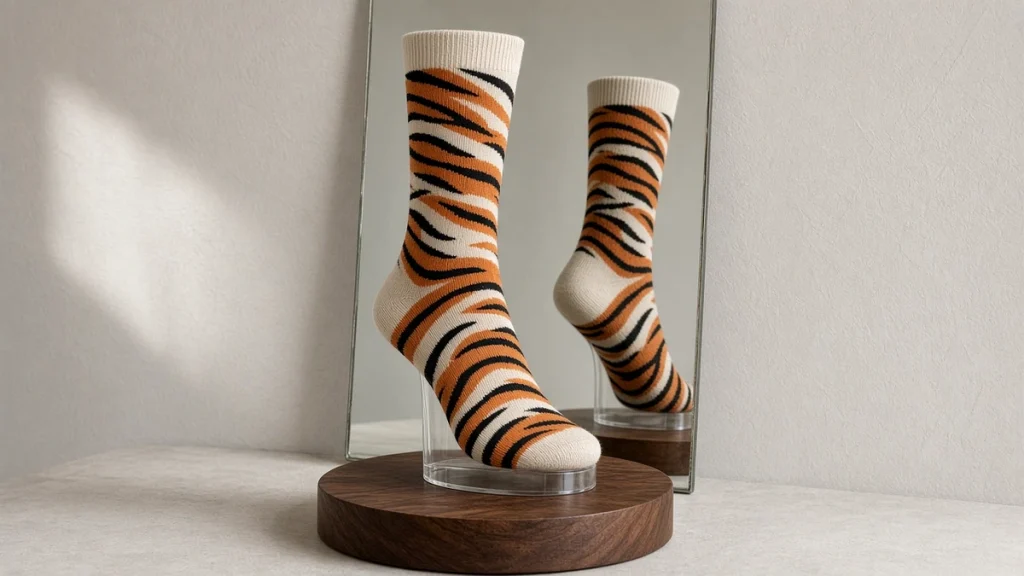
"360 sock printing" has become a common phrase among sock brands and print shops. It describes printing a design all the way around a sock, so the artwork flows continuously with no break at the sides. It is the main reason modern printed socks look so different from older flat-printed versions.
The problem with flat printing
When a sock is printed flat, by sublimation transfer or screen printing, it is folded along both sides. The print covers the front and back but cannot reach evenly into the folds. When the sock relaxes or is worn, those fold lines appear as pale stripes. Designers can hide them with borders or dark colors, but they limit what is possible.
How 360 sock printing works
In 360 sock printing, the sock is pulled over a cylindrical roller. A 360 sock printer rotates the roller under inkjet printheads while the carriage travels along the length. Ink is applied around the entire circumference, so there are no folds and no side lines. The design is continuous, just like a pattern knitted into the fabric, but with photographic detail and unlimited colors.
The technique is also called rotary printing; our rotary socks printer article explains the mechanics.
Why it looks better
- No side lines. The design wraps cleanly around the leg.
- Better stretch performance. Socks are printed close to their worn stretch, so colors stay even when worn.
- All-over designs. Patterns can cover cuff to toe.
- Photo quality. Gradients, faces and fine detail reproduce well.
Designing for 360 printing
Design on a template whose width equals the stretched circumference on the roller. The left and right edges meet, so the artwork must join seamlessly. Our guides to artwork preparation and 360 sock printing design mistakes cover the details.
Which fibers work?
- Polyester: disperse ink and heat fixation; the most common route.
- Cotton: reactive ink, pretreatment, steam or low-temperature fixation, washing and drying.
- Nylon and wool: typically acid ink and steaming.
What products benefit?
Beyond socks, 360 printing suits any tubular stretch product: ice sleeves, arm sleeves, beanies, neck gaiters, sweatbands and seamless yoga wear. Browse examples in our applications gallery.
Equipment for 360 sock printing
A complete setup includes:
- A 360 sock printer with rollers for your sizes. See the socks printer range.
- RIP software with fabric-specific profiles.
- A fixation oven for polyester, such as the COHE-1801, or a steamer and washing line for cotton.
Is 360 printing more expensive?
The equipment costs more than a basic heat press, but per-pair labor is lower at volume because there is no paper handling, and the result commands higher prices. For many brands, the quality improvement alone justifies the switch. Our socks printer vs sublimation transfer article compares the economics.
Where 360 sock printing shines
Seamless wraparound printing is especially valuable for designs that customers view from every angle:
- All-over patterns such as florals, geometrics and camouflage.
- Photo designs of pets, people or places, where a seam line would interrupt the image.
- Gradients and tie-dye effects, which look unnatural with visible joins.
- Team and event socks with names or numbers placed precisely around the leg.
How the seamless effect is achieved
On a rotary socks printer, the sock is pulled over a roller and rotates under the printheads, so the design is printed continuously around the tube. The artwork is prepared as a flat wrap that joins at its edges. Good results depend on correct roller size, even stretching of the sock and accurate file preparation. See 360 sock printer rollers.
Limits to understand
Seamless printing covers the tube of the sock, but some areas such as the very inside of the toe or the welt may print differently because of their construction. Stretch also changes how designs look when worn. Test designs on real feet, not just flat on rollers.
Getting started
If you are new to 360 sock printing, begin with forgiving designs such as patterns, then move to photos and detailed artwork as you learn. Read the 360 digital socks printing workflow and 360 sock printing design mistakes to avoid. Examples are on the custom printed socks page.
Frequently asked questions
Is 360 sock printing the same as 3D sock printing?
Sellers sometimes use "3D" to describe the wraparound effect, but it is the same seamless rotary process. See what is a 3D socks printing machine.
Can you see a join anywhere?
With correctly sized artwork and careful loading, the join should be invisible.
Does it work on dark socks?
Digital dye inks are transparent, so white blanks are used and the background color is printed.
Can I print both socks of a pair identically? Yes, using the same file and settings, though small differences from stretching are normal.
Does seamless printing work on cotton? Yes, with reactive inks and the proper pretreatment and finishing.
Conclusion
360 sock printing wraps designs seamlessly around the sock, eliminating side lines and enabling all-over, photo-quality designs. It has become the standard for premium printed socks. Explore our 360 socks printer models or contact us to learn more.
Leave A Comment