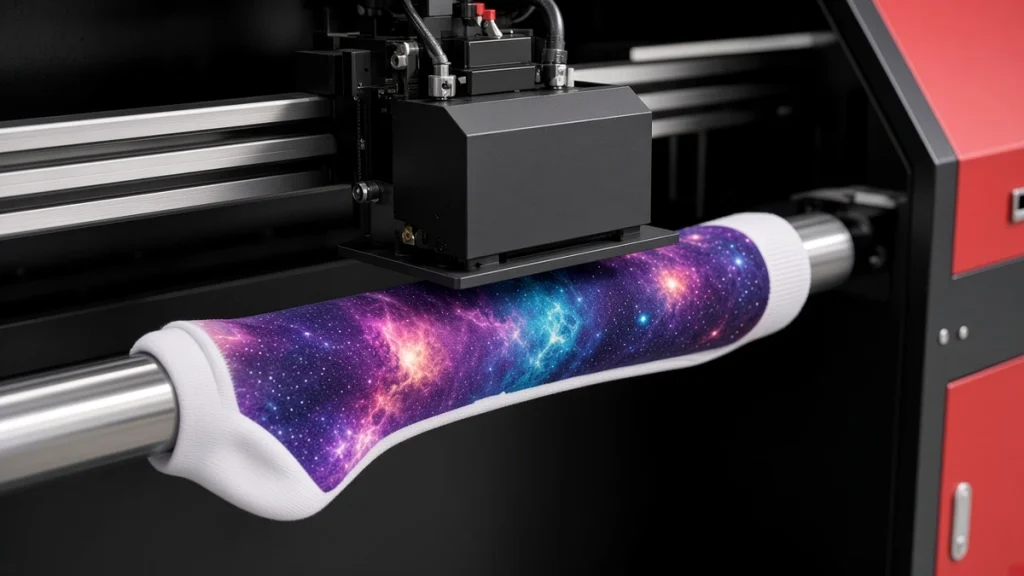
If you search online for sock printing equipment, you will see the phrase "3D Socks Printing Machine" frequently. It sounds like a machine that builds socks layer by layer, the way a 3D printer builds plastic parts. In reality, the term usually describes something different. Clearing up the confusion helps buyers compare equipment correctly.
What "3D" usually means in sock printing
In most listings, "3D" refers to printing on a three-dimensional object, the tubular sock, rather than on flat fabric. The sock is mounted on a cylindrical roller and printed all the way around. Some sellers also use "3D" to describe the visual effect of photo-realistic, all-over designs that appear to have depth.
So a 3D socks printing machine is, in practice, a rotary 360° digital socks printer. The same technology is also called a 360 sock printer or a seamless socks printer. See what is 360 sock printing.
What it is not
It is not additive manufacturing. The machine does not create the sock; it decorates an existing knitted blank with ink. Socks are still knitted on knitting machines before printing.
How the technology works
- A blank sock is pulled over a roller sized for it.
- The roller rotates under inkjet printheads while the carriage moves along its length.
- Ink is applied around the full circumference.
- The sock is fixed with heat or steam and, for cotton, washed and dried.
Learn more in rotary socks printer explained.
Why the 3D label became popular
- Sellers wanted to distinguish seamless printing from flat transfer printing.
- "3D" suggests realism and depth, which matches photographic designs.
- Search behavior: buyers type "3D socks printing machine," so sellers use the phrase.
What to ask when you see the term
Because "3D" is used loosely, ask suppliers:
- Does the machine print on a rotating roller, all around the sock?
- Which printheads and inks does it use?
- What sock sizes and print lengths does it support?
- What fixation and finishing equipment is needed?
- Can I see sample prints on my own blanks?
Our buying checklist provides a complete list.
Watch out for misleading listings
Some listings show heat presses or flatbed printers with jigs under the "3D" label. These print flattened socks and may leave side lines. Look for a roller-based design if you want seamless results.
Configurations
Rotary "3D" sock printers come in desktop, single-roller, twin-roller and four-roller versions. Compare them in the Ningbo Colorido lineup, or view the socks printer comparison.
How to talk to suppliers about "3D" printing
Because "3D socks printing machine" is used for different things, ask suppliers to be specific. Useful questions include:
- Does the machine print directly onto finished socks, or onto paper or fabric that is later transferred?
- Does the print wrap seamlessly around the sock, or only cover one side?
- Which fibers and inks does it support?
- Is any raised or textured effect produced, or is the "3D" description about the wraparound coverage?
- Can I see samples printed on my own blanks?
Clear answers help you compare machines fairly and avoid buying equipment that does not match your expectations.
What buyers usually want
In most enquiries, buyers using the term "3D" want seamless, all-over designs with no white line down the side, printed on ready-made socks in small quantities. That is what a rotary 360 socks printer is designed to do. Read what is 360 sock printing and rotary socks printer explained.
Describing your products honestly
If you sell printed socks, describe them in terms customers understand, such as "all-over 360 print" or "seamless wraparound print," and avoid suggesting effects the product does not have, like raised texture. Honest descriptions reduce returns and build trust.
Related reading
For the broader landscape of equipment, see the socks printing machine guide and custom socks machine options. Browse available models on the socks printer page, or view finished examples on the custom printed socks page.
Frequently asked questions
Can a 3D socks printing machine print shoes or rigid objects?
No. It is designed for stretchable tubular textiles like socks, sleeves and beanies.
Is "3D" sock printing more durable?
Durability depends on ink and fixation, not the label. Properly fixed prints are durable.
Is it suitable for cotton?
Yes, with reactive ink and the cotton finishing route.
Can a socks printer create a raised 3D texture? Digital dye printing colors the fiber rather than building a raised layer, so the surface stays smooth.
Is "3D" the same as "360"? In everyday use they are often used for the same seamless, wraparound result, but ask to be sure.
Do 3D-looking designs need special artwork? Shading and perspective in the artwork can create a visual depth effect; the printer reproduces what is in the file.
Conclusion
A "3D Socks Printing Machine" is almost always a rotary 360° digital printer that prints seamlessly around the sock. Focus on how the machine prints, what it supports and real sample results rather than the label. Explore true rotary models on our socks printer page or ask us to clarify any listing you have seen.
Leave A Comment