Sublimation transfer is how many sellers first make printed socks. You print a design on transfer paper, slip a flattened polyester sock onto a jig, and press it in a heat press. It is affordable to start and widely taught online. So why are so many sock businesses switching to a dedicated socks printer? The answer comes down to the seam line, speed and consistency.
How sublimation transfer works
With transfer sublimation, the sock is stretched over a flat jig, usually a sock-shaped board. Transfer paper printed with sublimation ink is placed on both sides and pressed with heat. The dye turns into gas and bonds with the polyester fibers.
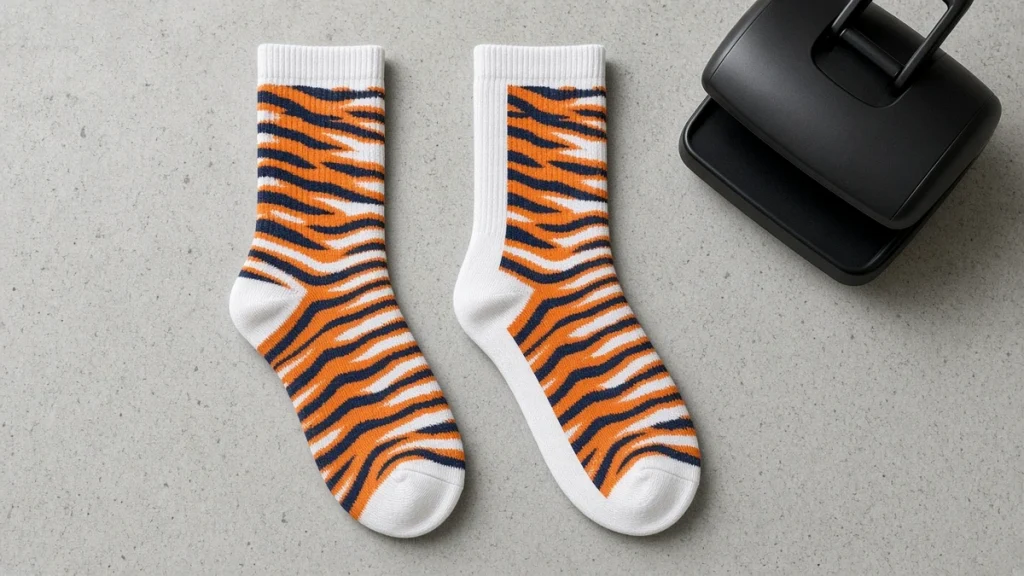
Because the sock is flattened, there are two folded edges along the sides where the paper does not reach evenly. When the sock is removed and relaxes, those edges show as pale or white lines. Clever artwork can hide them, but they remain a known limitation.
How a socks printer works
A socks printer places the sock on a cylindrical roller instead of a flat jig. Inkjet heads print directly on the fabric as the roller turns, wrapping the design around the full circumference. There is no fold and therefore no side line. The design can flow continuously around the leg, which is exactly what 360 degree seamless socks printer buyers are looking for.
For polyester, the ink is still a disperse (sublimation-type) dye fixed with heat, but fixation happens in an oven after printing rather than in a press.
Quality comparison
- Side lines. Transfer: visible unless hidden by design. Socks printer: none.
- Color across the stretch. Transfer prints on the sock in a semi-stretched state; when worn, stretched areas can look paler. Rotary printing stretches the sock on a roller close to its worn size, so colors hold up better when worn.
- Detail. Both can produce sharp detail; the roller approach keeps the image continuous around the leg.
- Cotton. Transfer sublimation does not work on cotton. A socks printer can print cotton with reactive ink and the right finishing.
Speed and labor
Transfer sublimation involves several manual steps per pair: printing paper, cutting, positioning, pressing, peeling and checking. Each press cycle handles one or two socks. A socks printer removes paper handling entirely, and multi-roller designs keep the printheads busy while the operator loads the next sock. For businesses printing more than a few dozen pairs per day, the labor difference becomes significant.
Consumables and waste
Transfer sublimation consumes paper and protective sheets for every pair, plus ink that never reaches the sock. Direct printing uses ink only where it is needed and eliminates paper waste. If sustainability matters to your customers, our article on sustainable sock printing covers this in more depth.
Start-up cost
Here transfer sublimation clearly wins: a small printer, heat press and jigs cost far less than an industrial socks printer and oven. That is why it remains popular with hobbyists and very small sellers. The question is what happens when orders grow. Many businesses reach a point where labor and seam-line complaints cost more than the equipment saving.
When transfer still makes sense
- Testing the market with a handful of designs.
- Very low volumes where labor cost is not a concern.
- Designs where side lines are part of the look or hidden in a dark border.
When to move to a socks printer
- Customers ask for seamless all-over prints.
- You want to offer cotton or blended socks.
- Daily volume makes paper handling a bottleneck.
- You need consistent quality across operators and shifts.
Making the switch
Businesses moving from transfer to direct printing usually keep their design library but adapt templates to the roller format. Our guide to preparing artwork for a socks printer covers the changes. You will also need a heat-fixation oven for polyester; the compact COHE-150 benchtop oven is a common starting point, while larger chain ovens suit continuous production.
What customers notice first
When a customer turns a sock in their hand, the first thing they look at is the side and back. Transfer-printed socks often show a line or a faded band where the paper met or folded. Socks from a rotary socks printer show the design continuing all the way round. For photo and pattern designs this difference is obvious; for a small logo it may matter less.
Choosing by product type
- All-over patterns and photos: direct 360 printing avoids seam lines.
- Small logos on one side: transfer may be acceptable.
- Cotton-rich socks: sublimation transfer does not suit cotton, while a socks printer with reactive ink can print it. See printing cotton socks on a socks printer.
Conclusion
Sublimation transfer is a low-cost entry point, but it carries built-in limits: side lines, polyester only and heavy manual handling. A socks printer prints in the round, supports more fibers and scales better. If seamless quality and growth are your goals, compare the socks printer models or ask us for sample prints on your own blanks.
Leave A Comment