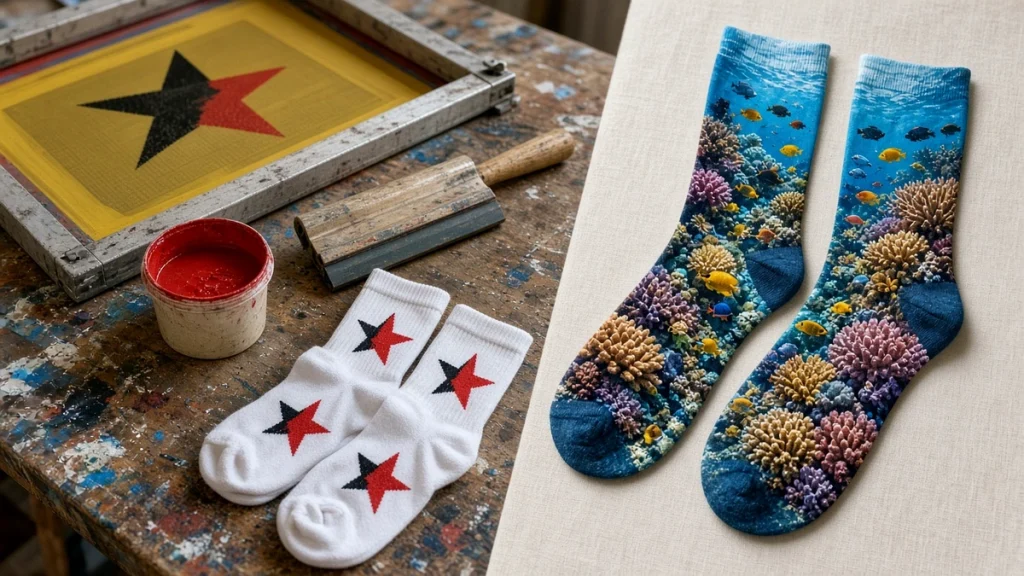
Screen printing has decorated textiles for decades, and many sock businesses started there. Digital socks printers are newer, but they have changed what customers expect from a printed sock. If you are deciding between the two, or wondering whether to add digital capacity to a screen shop, this comparison will help.
How screen printing works on socks
Screen printing pushes ink through a fine mesh stencil onto the fabric. Each color needs its own screen, and each screen must be prepared, registered and cleaned. For socks, the item is usually flattened on a board, which means the print covers one side or two separate faces rather than the whole tube.
Screen printing shines when you need thousands of identical pieces with a few solid colors. Once the screens are set up, each impression is quick.
How a socks printer works
A socks printer is a digital inkjet machine. The sock is pulled over a roller, and the printheads lay down the full design as the roller turns. There are no screens to prepare; changing designs is as simple as loading a new file. Because the sock is printed in the round, artwork can wrap 360 degrees with no visible side join. The complete beginner's guide explains the parts of the machine.
Comparison by factor
Setup time. Screen printing needs screen preparation for every color and design. A socks printer needs a file and a color profile. For short runs, digital wins clearly.
Number of colors. Screen printing becomes more expensive with each extra color. Digital printing reproduces full color, gradients and photographs at no extra setup cost.
Coverage. Flat screen printing struggles with all-over wraparound designs. A socks printer is built for seamless all-over coverage.
Run length. For very long runs of a one- or two-color logo, screen printing can be economical per piece. For short and medium runs, especially with many designs, digital is usually cheaper overall.
Personalization. Printing a different name or photo on each pair is impractical with screens. With a socks printer, every pair can be different. This makes digital the natural choice for personalized socks.
Hand feel. Screen ink can sit on top of the fabric and feel heavier. Digital dye inks penetrate the fiber, so the sock keeps its stretch and softness.
Waste. Screen printing uses emulsions, cleaning chemicals and test prints for each setup. Digital printing produces less setup waste, though it still needs pretreatment and fixation.
Where each method makes sense
Screen printing still fits:
- Very large runs of a simple logo in one or two colors.
- Shops that already have screen equipment and skilled staff.
- Products where a raised ink effect is part of the look.
A socks printer fits better for:
- All-over, photographic or gradient designs.
- Many designs in small quantities.
- Personalized and print-on-demand orders.
- Brands that want to test new designs quickly.
Running both
Some businesses keep screen printing for bulk logo jobs and add a socks printer for everything else. This hybrid approach lets them say yes to more customers without forcing every order into the same process. Over time, many find that the digital side grows faster because it handles the custom work customers increasingly ask for.
Cost considerations
When comparing costs, include the hidden ones: screen preparation time, storage of screens, reprints when registration slips, and inventory of pre-printed stock. Digital printing shifts cost toward ink and finishing but removes most setup and inventory costs. Our socks printer ROI guide shows how to compare them for your own volumes.
Quality expectations today
Customers now see seamless, full-color socks in stores and online. For many designs, especially art, pets and photographic patterns, a flat screen-printed sock with visible side lines looks dated by comparison. That shift in expectations is one of the main reasons sock brands are moving to 360 sock printing.
Making the decision in practice
The easiest way to decide is to sort last year's orders by quantity and design type. If most orders are large runs of one- or two-color logos, screen printing may still make sense for those jobs. If many orders are small, multi-color, photographic or personalized, a socks printer usually handles them with less setup and less waste.
Running both methods
Some decorators keep screen printing for very large single-design runs and move everything else to digital. The key is to price each method honestly, including setup, screens, cleanup and rejects, rather than ink alone. Our socks printer ROI guide explains a simple way to compare costs per pair, and low MOQ custom socks covers the small-order side.
Conclusion
Screen printing remains a solid choice for high-volume, few-color logo work. A socks printer is the better tool for colorful, seamless, short-run and personalized socks. If you are unsure which mix suits your orders, browse the socks printer models or talk to our team about the designs you print most often.
Leave A Comment