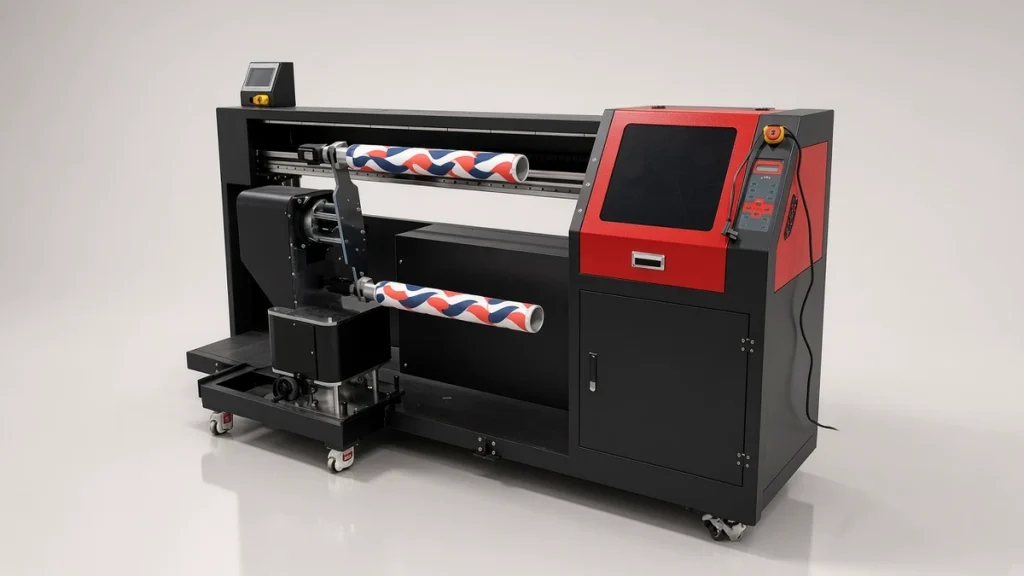
Specification sheets for a sock printing machine can be long and confusing. Some numbers matter a lot for daily production; others matter little. This article highlights eight features worth examining closely, explains why each matters and suggests questions to ask suppliers.
1. Roller system and sizes
Rollers hold the sock during printing. Their diameter must match sock circumference so fabric is stretched correctly. Check:
- Which roller sizes are included?
- Are custom sizes available?
- How quickly can rollers be changed?
- How many rollers does the machine run at once?
Multi-roller layouts let operators load while another roller prints. Compare layouts in four-roller vs twin-roller socks printer.
2. Printheads
Printheads determine detail, speed and reliability. Ask which heads are used, how many, and how easy they are to source. Ningbo Colorido's sock models use Epson I1600 heads, which are widely used in textile printing. Availability of replacement I1600 printheads matters for long-term running costs.
3. Maximum print length
Standard socks need modest print lengths; long tube socks, sleeves and leggings need more. If you plan to expand your product range, check that the machine can handle it. Some models support print lengths up to around a meter.
4. Ink system
A stable ink system prevents air bubbles and pressure changes that cause missing lines. Look at:
- Bulk ink tanks and how easy they are to refill.
- Dampers and filters.
- Ink circulation features.
- Which ink types the machine supports.
Read more in digital socks printer inks.
5. Software and RIP
Software turns designs into prints. Good software provides accurate color profiles, adjustable ink limits, print modes, job queues and template handling. Ask whether profiles for your fabrics are included and who supports the software. Our article on RIP software explains its role.
6. Build quality and stability
A stable frame and precise motion keep prints sharp at speed. Look at the carriage rails, roller drive and overall construction. If you visit the factory, watch how smoothly machines run over long periods.
7. Ease of maintenance
Daily maintenance should be quick. Check how easy it is to access the capping station, wipers and dampers, and whether consumables like cleaning sticks and capping parts are readily available. Machines that are easy to maintain are maintained more consistently.
8. Support and training
The best sock printing machine is the one that keeps running. Ask about:
- Training at installation.
- Remote support hours and methods.
- Spare parts lead times.
- Local service options.
Features that matter less than you think
- Maximum theoretical speed printed in large type; real output depends on design, resolution and loading.
- Long lists of compatible file types; most workflows use a few standard formats.
- Cosmetic extras that do not affect print quality or uptime.
Match features to your business
A print-on-demand seller values quick changeovers and size flexibility. A factory values continuous output and robustness. A promotional company values fast sampling. Rank the eight features by your priorities before comparing machines. Our buying checklist helps structure the comparison.
Weighing the features against each other
No machine is best at everything. Rank the features by what matters for your business. A print-on-demand shop may rank ease of roller changes and file workflow highest; a factory may rank throughput and durability first. Score each shortlisted sock printing machine against your ranking rather than against a supplier's list of highlights.
Testing features in a demo
- Roller changes: time how long it takes to switch sizes.
- Loading: try loading socks yourself, not just watching.
- Software: ask to see the RIP and job queue in use.
- Maintenance: ask the operator to show daily cleaning steps.
- Seam alignment: inspect where the print meets on several pairs.
Features that are easy to overlook
Documentation in your language, availability of spare parts, remote support and training often matter as much as print speed. A machine that is quick but hard to maintain may produce less over a month than a simpler one that runs reliably.
Further reading
See the sock printing machine FAQ, socks printing machine guide and rotary socks printer explained. For model details visit the compare page.
Write your scores down during each demo, while details are fresh, and compare them afterwards.
Frequently asked questions
How many printheads do I need?
More heads can increase speed or add color channels. For most sock work, two heads are common; production models may offer more. Match head count to your output and color needs.
Do rollers wear out?
Rollers are durable, but scratches or deformation can affect loading. Handle them carefully and inspect regularly.
Is touchscreen control important?
It is convenient, but software stability and workflow matter more than the interface style.
Conclusion
When comparing a sock printing machine, focus on rollers, printheads, print length, ink system, software, build quality, maintainability and support. These eight features determine daily quality and uptime. Compare models side by side on our comparison page or contact us for advice.
Leave A Comment