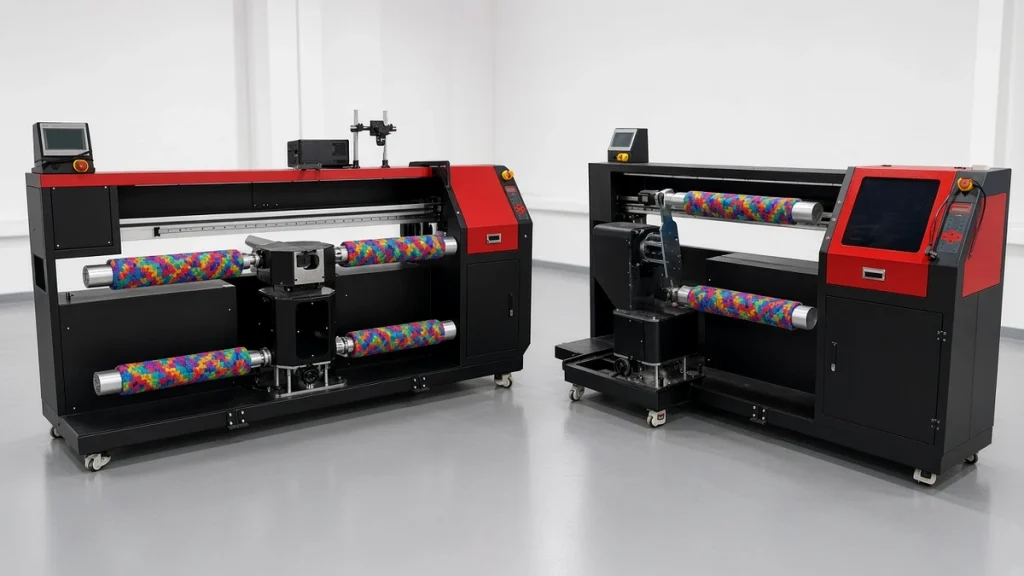
When buyers compare socks printers, roller count is one of the first differences they notice. A single-roller machine prints one sock at a time. Twin-roller and four-roller machines add more rollers so that loading and printing can overlap. But more rollers do not automatically mean a better machine for every business. This article explains what roller layout really changes.
Why roller count matters
On any socks printer, a sock must be loaded onto a roller before printing and removed afterwards. With a single roller, the printheads wait while the operator does this. Additional rollers let the operator prepare the next sock while one is printing, reducing idle time for the heads. In other words, roller count is mainly about keeping the most expensive part of the machine busy.
The twin-roller layout
A twin-roller machine typically has two print positions. While one roller prints, the operator loads or unloads the other. This layout:
- Raises output compared with single-roller machines.
- Remains easy for one operator to manage.
- Often supports a wider range of roller diameters and longer print lengths.
The CO60-100PRO twin-roller socks printer is an example. Its site listing describes support for socks, sleeves and flexible tubular work, with print lengths up to around a meter. That flexibility makes twin-roller machines popular with businesses that print a mix of socks, long tube socks and sleeves.
The four-roller layout
A four-roller machine adds more stations so that printing can continue almost without pause. In the CO80-210PRO four-roller socks printer, an innovative multi-roller rotary system enables continuous automatic printing, which significantly increases output for sock-focused production.
Four-roller layouts suit:
- Factories and print rooms with steady daily demand.
- Teams with a dedicated loader keeping pace with the machine.
- Production focused mainly on standard sock sizes.
Comparing the two
Output. Four-roller machines are designed for higher continuous output. Twin-roller machines deliver solid output with more flexibility.
Product range. Twin-roller machines often accept longer products and a broader roller range. Four-roller machines focus on efficient sock production.
Staffing. A twin-roller machine fits a single operator who also handles other tasks. A four-roller machine reaches its potential when one person focuses on loading.
Floor space. Larger multi-roller machines need more length; check the dimensions against your room.
Workflow fit. If your orders are many different products in small quantities, flexibility matters more than peak speed. If you print large volumes of standard socks, continuous output matters more.
What about single-roller and desktop machines?
Single-roller multifunction machines like the CO70-220PRO and compact desktop units like the CO80-600DK are excellent for entry-level production, sampling and studios with limited space. Many businesses start with one of these and add a multi-roller machine as orders grow. Our article on whether a desktop socks printer is right for a small studio goes deeper.
Matching layout to finishing capacity
A faster printer only helps if your fixation and finishing can keep up. A four-roller machine printing polyester socks pairs naturally with a continuous chain oven, while a twin-roller machine may be well matched to a smaller oven. Plan the whole line together; see planning a production line around your socks printer.
Questions to ask yourself
- What share of my orders are standard socks versus long or unusual products?
- Will someone be dedicated to loading the printer full time?
- What daily output do I need in year one and year two?
- Does my finishing equipment match the printer's output?
How the layouts feel on the shop floor
Numbers on a specification sheet do not show how a machine feels to operate. With a twin-roller layout, the operator works in a steady rhythm: load one roller while the other prints. The workflow is simple to learn and suits a single operator who also handles other tasks.
A four-roller layout gives more time between loading steps, which can raise output when the operator focuses only on the printer. It also means more rollers to keep clean and sized correctly, and more socks in progress at once. Ask the supplier to show both layouts running, ideally on video with real operators.
Decision points
- Staffing: will someone be dedicated to the socks printer, or shared with finishing?
- Order mix: many small personalized orders favor simple, flexible loading; long runs of one design favor more rollers.
- Downstream capacity: a faster printer only helps if your sock oven and packing can keep up.
- Growth plan: two smaller machines give redundancy; one larger machine saves floor space.
Compare current options on the compare page, and see scaling up with a second socks printer.
Conclusion
Twin-roller socks printers offer flexibility and strong output for mixed product ranges. Four-roller machines maximize continuous output for focused sock production. Neither is better in absolute terms; the right choice depends on your products and staffing. Use the socks printer comparison table to review published figures, or contact our team for a recommendation based on your order profile.
Leave A Comment