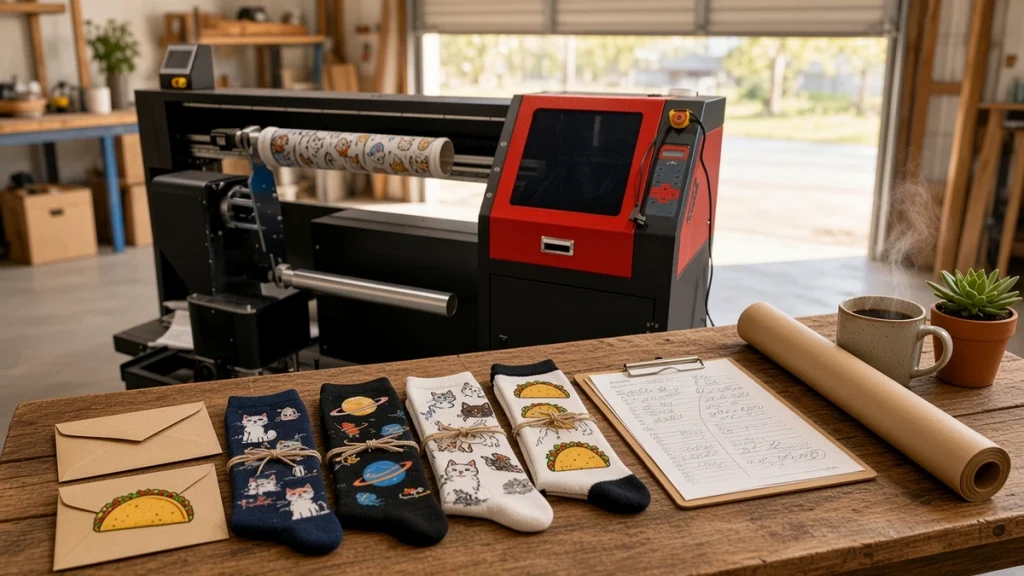
Custom socks are one of the most approachable products in apparel. They fit almost everyone, they make great gifts, and they are an easy way for people to express personality. Owning a socks printer lets you design, produce and ship them yourself instead of relying on suppliers with high minimum orders. This roadmap covers the decisions that matter most in the first year.
1. Pick a clear niche
The custom sock market is broad. Successful new businesses usually start narrow:
- Pet portraits and breed designs.
- Sports teams and clubs.
- Corporate and event gifts.
- Holiday collections.
- Art and illustration brands.
- Personalized photo socks.
A clear niche makes marketing easier and helps you choose materials and designs. Our list of personalized socks business ideas can spark options. You can also browse the applications gallery for examples of what printed socks look like across themes.
2. Decide how customers will order
Will you sell through your own website, marketplaces, wholesale to shops, or B2B to companies? Each channel changes how many designs you handle and how quickly you must ship. Online personalization favors fast single-pair production; wholesale favors batches of the same design.
3. Choose your materials
Polyester is popular for printed socks because it produces vivid colors and has a shorter finishing route: print, heat-fix, pack. Cotton feels familiar and premium but requires pretreatment, steaming or low-temperature fixation, washing and drying. Many new businesses start with polyester and add cotton later. Ready-made blank polyester socks and blank cotton socks designed for printing simplify early sourcing.
4. Choose the right machine size
Do not buy for the dream; buy for the next two years. A desktop socks printer or single-roller model suits a founder doing everything personally. Twin-roller and four-roller models become worthwhile once you have steady daily orders and dedicated staff. Our article on choosing the right socks printer walks through the options.
5. Plan your workspace
You need room for the printer, fixation equipment, a design computer, a packing table and storage for blanks. Check your electrical supply and plan ventilation and climate control. Keep the print area clean; lint is the enemy of printheads.
6. Build a design system
Create templates for each sock size you sell, a color-tested palette, and a naming system for files. Good organization saves enormous time once you have hundreds of designs. Learn the specifics in preparing artwork for a socks printer.
7. Get color right early
Print test swatches on your actual blanks and compare them to your screen. Build or obtain color profiles for each fabric. Customers notice when a "navy" sock arrives looking purple. See socks printer color management.
8. Price for profit
Include blanks, ink, fixation energy, labor, packaging, payment fees, shipping and reprints. Personalized items deserve higher prices because every pair is unique. Make sure you leave room for advertising costs.
9. Set up fulfillment
Decide how orders flow from your shop to the printer and back to shipping. Even a simple spreadsheet works at first, but connecting your store to a production queue saves time as volume grows. See connecting your online store to a socks printer workflow.
10. Market with real photos
Because you print on demand, you can photograph real samples of every design. Short videos of the socks printer in action also perform well on social media; customers love seeing how their socks are made.
Common first-year mistakes
- Buying a large machine before having steady orders.
- Underestimating finishing equipment and space.
- Ignoring maintenance until heads clog.
- Launching hundreds of designs instead of testing a focused collection.
Your first 90 days
A clear plan for the first three months keeps a new sock business focused.
Month one: learn the process
Install the socks printer, complete training and print test designs on your chosen blanks every day. Record settings that give good results and wash-test samples. Do not take large orders yet.
Month two: soft launch
Launch a small collection to friends, local shops or an online audience. Fulfil every order yourself so you understand packing, shipping and customer questions. Note any defects and their causes.
Month three: refine and grow
Drop designs that do not sell, add variations of the ones that do, and start approaching business customers such as clubs, schools or companies. By now you should know your real cost per pair, which lets you price confidently.
Common early mistakes
- Launching too many designs at once.
- Skipping wash tests before selling.
- Underpricing to win the first customers.
- Ignoring packaging and photos.
Useful next reads: pricing print on demand socks, personalized socks business ideas and choosing blank socks.
Conclusion
A socks printer gives a new sock business control over quality, speed and creativity. Start with a niche, choose a realistic machine size, plan the full production line and invest in color and design systems early. When you are ready to compare equipment, explore our socks printer lineup or contact us with your plans.
Leave A Comment