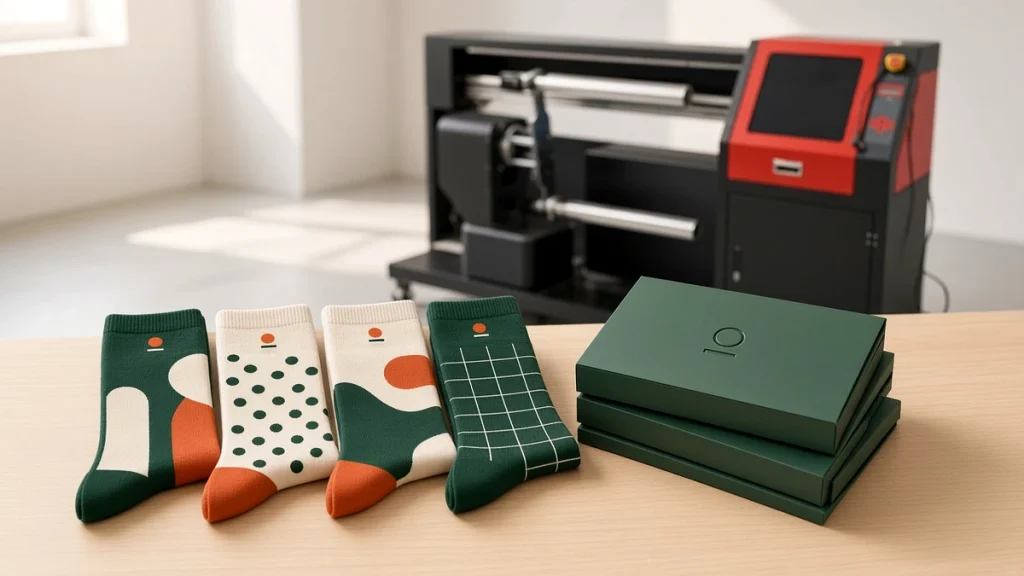
For years, most sock brands outsourced production. They designed in-house, sent files to a factory and waited weeks for bulk orders. Today a growing number of brands are bringing printing in-house with a custom socks printer. Owning production changes how quickly a brand can move, how much inventory it carries and how much control it has over quality.
Why brands outsource, and the trade-offs
Outsourcing offers scale and no equipment investment. But it comes with:
- Minimum order quantities per design.
- Long lead times, especially overseas.
- Inventory risk on designs that do not sell.
- Limited ability to personalize.
- Less control over timing and quality.
What changes with an in-house custom socks printer
Speed. New designs can be sampled and launched within days.
Small batches. Print what sells; restock winners quickly.
Personalization. Offer names, photos and limited editions.
Quality control. Approve every batch yourself.
Confidentiality. Unreleased designs stay in-house.
Is it right for your brand?
In-house printing makes sense when:
- You release many designs or seasonal collections.
- You sell online and value fast restocking.
- You want to offer personalization.
- Your volume justifies equipment and staff.
It may not make sense when:
- You sell very large volumes of a few designs.
- You have no space or staff for production.
- Your product relies on knitted jacquard patterns.
Many brands adopt a hybrid: outsource core knitted lines, print limited and personalized lines in-house. See jacquard socks vs digitally printed socks.
Choosing equipment
Brands often start with a single-roller or twin-roller machine. The CO70-220PRO suits entry-level production; the CO60-100PRO adds flexibility for longer socks and sleeves. Add polyester fixation first, then cotton finishing if your brand uses cotton. Our buying guide covers the decision.
Building the team
You will need someone responsible for production: loading, printing, maintenance and finishing. Designers should learn sock templates and color management. Our operator training plan helps structure this.
Managing blanks
In-house printing shifts sourcing from finished socks to blanks. Choose blanks designed for printing, keep stock of each size and build relationships with reliable suppliers. Ready-made blank polyester socks can help early on.
Marketing advantages
Owning production gives brands stories to tell: behind-the-scenes videos, limited drops printed this week, personalized collaborations. Customers value transparency and speed.
Financial view
Compare the full cost of in-house printing, including equipment, blanks, ink, labor and space, with outsourced costs including minimums, freight and unsold inventory. Our ROI guide shows a simple method.
What changes when you own production
Bringing printing in-house changes how a brand works:
- Faster sampling: new designs can be printed and photographed within days.
- Smaller drops: limited editions become practical without large minimums.
- Direct quality control: color and finishing are checked by your own team.
- New responsibilities: equipment care, staff training and finishing space.
Planning the first months
Start with a limited range on one fiber, document your settings and build a routine for maintenance. Add designs, fibers and products once results are consistent. Our socks printer buying guide and socks printer ROI help with planning, and the socks printer page lists current models.
Protecting your brand standards
Owning production means owning quality. Write a short brand quality guide covering approved blanks, color references, acceptable tolerances at the seam and packing standards, so every operator works to the same expectations.
Frequently asked questions
Can a brand start small?
Yes. Compact machines let brands start with modest volume and scale up.
Will in-house quality match a factory?
With proper training, profiles and finishing, yes. Many brands find quality improves because they control every step.
How long until production is stable?
Typically a few weeks of practice after installation and training.
Do we need design skills in-house? Not necessarily. Many brands keep design with agencies or freelancers and run only production in-house. What you do need is someone who checks files against your templates. See preparing artwork for a socks printer.
Can we keep using our existing suppliers? Yes. Many brands print new and limited designs in-house and keep proven lines with existing factories.
How do we keep quality consistent? Approve a reference sample for every design, keep settings recorded, and wash-test new blank batches. Our troubleshooting guide helps when problems appear.
What about cotton? Cotton needs reactive inks plus steaming, washing and drying. Many brands start with polyester and add cotton later.
Where should the printer go? Ideally close to your design and dispatch teams, in a clean space with stable climate and suitable power. See socks printer workspace requirements.
Ask a supplier for a sample run of your first collection so you can test quality before planning a launch.
Conclusion
A custom socks printer gives brands speed, flexibility and control. Evaluate your release cadence, channels and volume, start with the right-sized machine and build a small production team. Explore our socks printer range or contact us to discuss bringing production in-house.
Leave A Comment