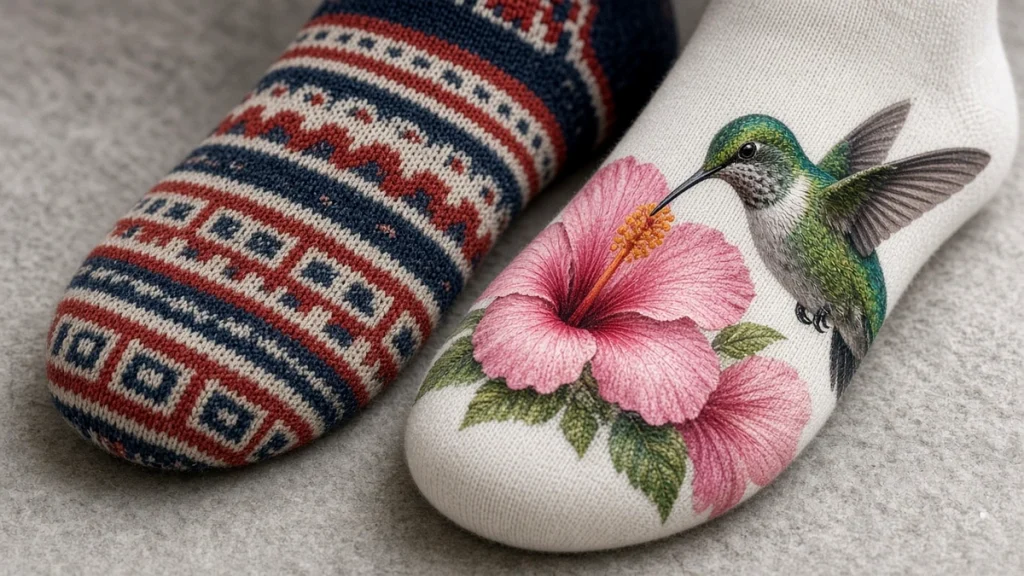
Walk into any sock shop and you will find two main types of patterned socks: jacquard socks, with patterns knitted into the fabric, and digital print socks, with designs printed onto the knitted sock. Both can look great, and many brands sell both. Here are the pros and cons of each from the perspective of a brand or retailer.
Jacquard socks: how they are made
Jacquard socks are knitted with multiple yarn colors. The knitting machine selects which yarn appears on the surface at each stitch, building the pattern into the fabric. Unused yarns float on the inside.
Jacquard pros
- Classic, premium texture. The knit structure gives depth.
- Colorfast by nature. Colors come from dyed yarns.
- Economical at scale for simple patterns in large runs.
- Traditional appeal for argyle, stripes and logos.
Jacquard cons
- Limited colors per design.
- Limited detail; no photographs or smooth gradients.
- Minimum orders and setup for each design.
- Longer lead times for programming and yarn.
- Inner floats can catch toes and add bulk.
Digital print socks: how they are made
A white blank sock is printed on a rotary digital printer, then fixed and finished. See how a socks printer works.
Digital print pros
- Unlimited colors and detail, including photos.
- No minimums; one pair is practical.
- Fast sampling and launches.
- Personalization.
- Smooth inside without floats.
- Seamless 360° designs with rotary printing.
Digital print cons
- Needs proper fixation to be durable.
- Equipment and finishing investment for in-house production.
- White base limits some looks.
- Surface texture is that of the base knit, not patterned.
Which to choose?
Choose jacquard for:
- Core classics in large volume.
- Designs where texture matters.
- Simple logos and stripes.
Choose digital print for:
- Art, photos and complex designs.
- Seasonal and limited drops.
- Personalized gifts.
- Fast trend response.
Using both
Many brands combine both techniques: a knitted logo at the cuff with a printed design on the leg, or jacquard core lines alongside printed seasonal collections. Read digital socks printer vs jacquard knitting for the production view.
Durability note
Both last well when made properly. For digital prints, durability depends on fixation; see how durable digital print socks are.
How customers perceive each type
Customers often describe jacquard socks as classic, textured and premium, and printed socks as fun, detailed and personal. Neither perception is better; they suit different moments. A business-casual argyle sock and a personalized dog portrait sock serve completely different purposes. Understanding this helps brands position each line clearly rather than competing against themselves.
Production planning for mixed ranges
Brands that offer both types usually plan them differently:
- Jacquard lines are forecast and produced in batches with longer lead times, focused on proven designs.
- Printed lines are released more frequently, tested in small quantities and restocked on demand.
This split balances the efficiency of knitting for steady sellers with the flexibility of digital printing for new and seasonal designs.
Combining both in one sock
A popular approach is a knitted cuff or heel detail in brand colors combined with a printed leg design. The knitted element provides texture and brand identity; the print provides unlimited creativity. Factories with knitting capacity can offer this combination directly. See adding a socks printer to a traditional sock factory.
Questions to ask before choosing a method
When a customer or your own team must choose between jacquard and printed socks, a few questions settle most cases:
- How many colors and how much detail does the design have? Photos and gradients point to printing.
- How many pairs, and how many designs? Many designs in small quantities point to printing; one design in large volume may suit knitting.
- Is texture part of the appeal? Raised or textured patterns need knitting.
- How soon is it needed? Printing usually allows faster samples and small runs.
- What fiber is required? Both methods work with many fibers, but printing needs the right ink and finishing for each.
Presenting both options
If you can offer both methods, show customers physical samples of each. Seeing and feeling the difference is the fastest way to a decision. Explain cost and timing honestly; customers appreciate advice that matches their goals rather than a push toward one method.
Related reading
See digital socks printer vs jacquard knitting, from jacquard socks to digital print and custom printed socks examples.
Whichever method you choose, approve a physical sample before bulk production.
Frequently asked questions
Are jacquard socks warmer?
Inner floats add a bit of thickness, which can add warmth.
Can digital printing mimic jacquard?
It can imitate the look visually, but not the texture.
Which is more sustainable?
On-demand digital printing reduces overproduction; jacquard avoids ink. See sustainable sock printing.
Conclusion
Jacquard socks offer texture and scale for classic designs; digital print socks offer detail, color, personalization and speed. Most modern sock brands benefit from both. To explore digital printing, see our printed socks range or contact us.
Leave A Comment