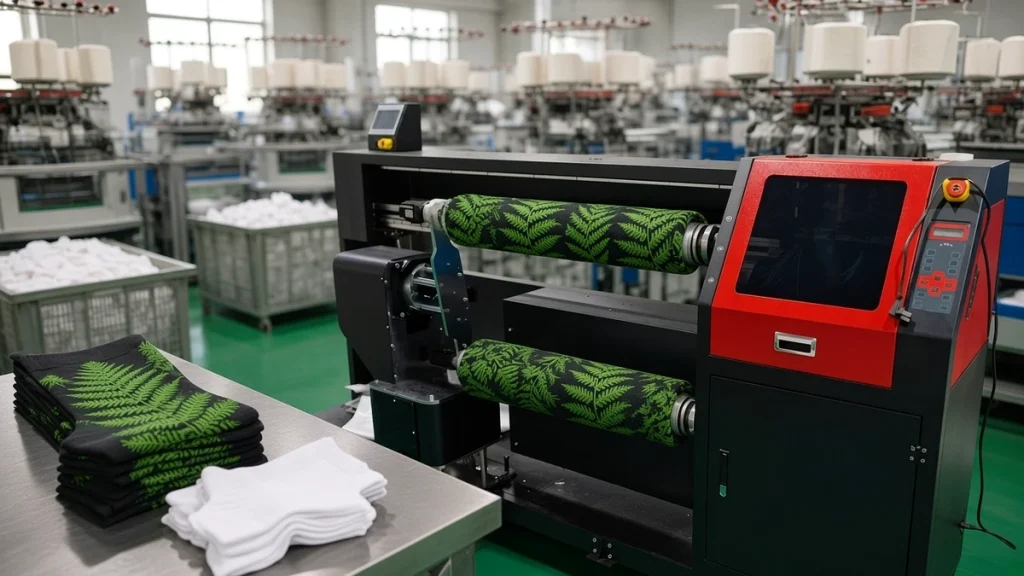
Traditional sock factories have deep expertise in knitting, linking, boarding and packing. Many are now adding digital printing to meet demand for colorful, customized and short-run socks. A socks printer complements knitting rather than replacing it: the factory keeps producing high-quality blanks and uses digital printing to add value.
Why factories are adding digital printing
- Customers want variety. Brands ask for more designs in smaller quantities.
- Lead times are shrinking. Retailers expect new designs quickly.
- Jacquard has limits. Knitted patterns are limited in colors and detail; photographic designs are impossible.
- Margins on plain socks are under pressure. Printed and custom socks command higher prices.
A socks printer addresses all four. It turns existing blanks into many different products without new knitting programs.
Knit and print: a natural combination
Factories that knit their own blanks have advantages that pure print shops do not:
- Control over fiber content optimized for printing.
- Consistent sizing that matches roller sizes.
- Lower blank costs.
- The ability to offer knitted features such as cushioning, heel shapes and cuffs combined with printed designs.
Our article comparing jacquard socks vs digitally printed socks explains how the two techniques can coexist in one product range.
Where the printer fits in the factory
Printing usually happens after the sock is knitted, toe-closed and, for some products, boarded. For polyester-rich socks, the route continues to heat fixation and then to final boarding and packing. For cotton, printed socks go through pretreatment, steaming or low-temperature fixation, washing and drying before final finishing.
Factories often already have washing and drying equipment, but it may not be suitable for printed socks without adjustment. The pretreatment and finishing equipment range is designed specifically for printed socks, from ovens and steamers to washers and dryers.
Choosing capacity
Factories typically need production-grade output. A four-roller machine like the CO80-210PRO is designed for continuous custom sock production, while a twin-roller model adds flexibility for longer tubes and sleeves. Many factories also add a small sampling machine so designers can test without interrupting production.
Organizing the team
Digital printing introduces new skills: design file preparation, color management and printhead maintenance. Factories often create a small digital team that works alongside knitting supervisors. Our operator training plan suggests how to structure onboarding.
Quality standards
Factories already have quality systems for knitting. Extend them to printing:
- Color approval against physical standards.
- Wraparound join inspection.
- Wash testing for each new fabric and ink combination.
- Rub and wear checks on samples.
Selling printed socks
The commercial side matters as much as the technical side. Factories can:
- Offer existing customers printed versions of current styles.
- Target new customers such as print-on-demand sellers and promotional companies.
- Provide sampling services that win orders quickly. See fast sampling with a socks printer.
- Develop their own brand for direct sales.
Avoiding common mistakes
- Treating printing as an afterthought rather than a dedicated department.
- Using blanks not optimized for printing.
- Skipping proper fixation and wash testing.
- Underestimating maintenance and environmental control.
A phased approach
- Pilot: one machine, polyester route, a few customers.
- Expand: add capacity and the cotton route once processes are stable.
- Scale: multiple machines, dedicated design team, automated order flow.
Fitting digital into existing production
A traditional sock factory already has knitting, linking, boarding, quality control and packing. A socks printer adds a decoration step, usually after the socks are knitted and closed, using plain white or light blanks. The key decisions are where the printing area sits in the flow and who runs it.
Practical integration steps
- Choose a pilot product, such as a printed polyester sports sock, rather than converting many lines at once.
- Select blanks from your own knitting, adjusting yarn and finishing if needed for good print results. See choosing blank socks.
- Train a small team of operators who can later train others. Our operator training plan helps.
- Set up fixation and, for cotton, finishing next to the printer to keep flow short.
- Offer samples to existing customers; many buyers welcome lower minimums and faster samples.
Commercial benefits
Printing lets a factory respond to small and urgent orders, test designs for buyers quickly and offer personalization that knitting cannot. It can also use plain blanks during quieter knitting periods.
Watch-outs
Printing has different skills from knitting: color management, file handling and printhead care. Budget time for learning. See the socks printer range and our factory tour for how printing fits in practice.
Measuring the pilot
Agree in advance what success looks like: perhaps a target defect rate, a sample turnaround time, or a number of repeat orders from existing buyers. Review the pilot after a few months before expanding to more lines.
Conclusion
A socks printer helps traditional sock factories turn knitting capacity into higher-value, customized products with shorter lead times. Integrate it as a dedicated department with the right finishing equipment, training and quality checks. Visit our factory tour to see production in action, or contact us to discuss integrating digital printing into your factory.
Leave A Comment