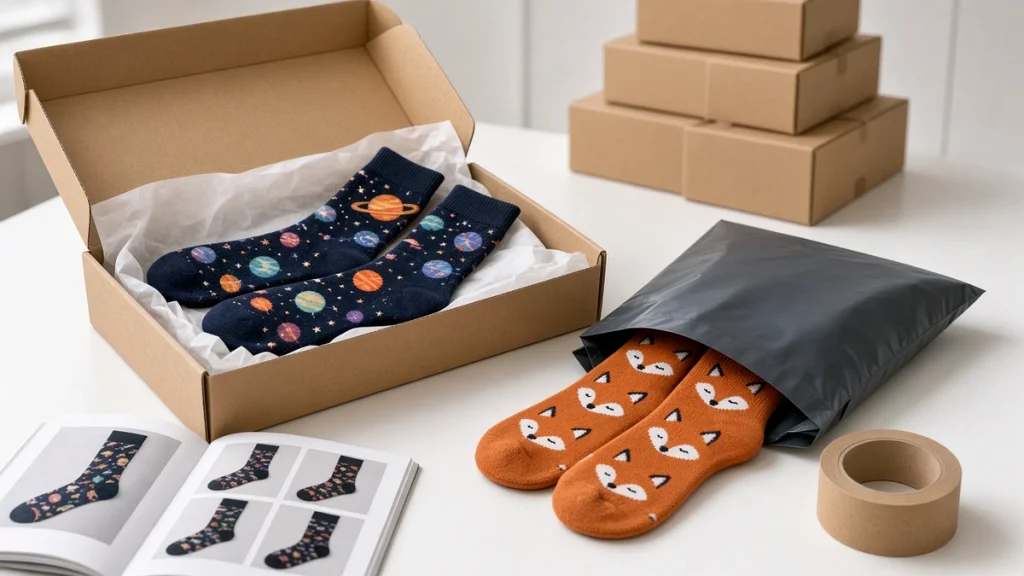
Print on demand socks let you sell hundreds of designs without holding inventory. Each pair is printed after a customer orders. The model has low financial risk and high creative freedom, but success depends on smooth production and fulfillment. This guide covers the essentials.
Two ways to do POD socks
1. Outsource to a POD provider. You design and sell; a provider prints and ships. Low investment, but less control over quality, speed and margins.
2. Print in-house. You own a socks printer and fulfill orders yourself or for other sellers. Higher investment, but better margins and control. This guide focuses on in-house POD. To decide between the two, compare in-house vs outsourced print on demand socks.
Choosing your niche and catalog
Successful POD sock stores focus on audiences: pet lovers, sports fans, professions, hobbies or holidays. Start with a focused collection, test, and expand winners. See personalized socks business ideas.
Equipment
- A socks printer suited to frequent design changes. Early-stage sellers often choose a single-roller or twin-roller model.
- A polyester heat-fixation oven.
- Blank polyester socks in your sizes.
- A computer with RIP software and a calibrated monitor.
- Packing supplies.
Polyester is the usual choice for POD because the route is short. Read why a socks printer is built for print on demand.
Catalog setup
- Create mockups from your templates.
- Use consistent SKUs that match file names.
- Define sizes clearly and map them to rollers.
- Write clear product descriptions, including material and care.
Fulfillment workflow
- Export orders in batches.
- Match SKUs to files; generate personalized files.
- Queue jobs in the RIP grouped by size.
- Print, fix and keep orders identified.
- Inspect and pack against packing slips.
- Upload tracking.
See connecting your online store to a socks printer workflow.
Shipping
Socks are light and compact, making shipping economical. Offer standard and express options, and set clear processing times.
Customer service
- Answer questions about sizing and care.
- Handle reprints quickly when something goes wrong.
- Ask satisfied customers for reviews and photos.
Quality control
Every pair is unique, so build quick checks: correct design, correct size, clean join, good color.
Selling channels
Your own store, marketplaces and social commerce all work. Read selling print on demand socks on Etsy and Shopify.
Pricing
Include blanks, ink, energy, labor, packaging, platform fees, shipping and advertising. See pricing print on demand socks profitably. Our step-by-step guide shows how to price print on demand socks for profit.
Order flow from click to parcel
A clean order flow keeps print on demand manageable:
- The order arrives from your store with design, size and quantity.
- The print file is generated or retrieved automatically.
- Orders are grouped by fiber and size into print batches.
- Socks are printed on a socks printer, then fixed and finished.
- Each pair is checked, packed and labeled for shipping.
- Tracking is sent back to the customer.
Every manual step is a chance for error, so automate file handling and labeling where you can.
Quality checks that matter
Check every pair for color accuracy, alignment at the seam, missed areas and stains. A quick visual check at packing is enough for most orders; personalized orders deserve an extra look at names and photos.
Customer service basics
Publish clear production and shipping times, sizing guidance and care instructions. Respond quickly to questions, and have a simple policy for misprints. Good service turns a novelty purchase into repeat orders.
Choosing what to make versus outsource
New print-on-demand sellers can either print in-house or use a fulfillment partner. Outsourcing lowers start-up costs but reduces control over quality and speed. Printing in-house with a socks printer gives control and higher margins once volume is steady, but requires equipment, space and skills. Many sellers start with a partner and move production in-house once they understand demand. Read why a socks printer is built for print on demand.
Setting expectations
Show production and shipping times clearly on product pages and in confirmation emails. Customers accept a few days of production for custom items when it is stated upfront. Missing a promised date damages reviews far more than a longer but accurate estimate.
Tracking key numbers
Watch order-to-dispatch time, defect and reprint rate, and customer contact rate. These tell you where to improve.
Planning your range
Begin with a focused range of designs and sizes, then expand based on sales. A smaller range means fewer blanks to stock, simpler roller changes and faster production on your socks printer.
Frequently asked questions
How many designs should I launch with?
Start with a focused set, enough to show range, then add based on sales data.
Can I offer cotton POD socks?
Yes, but the longer cotton workflow increases processing time.
What about returns?
Personalized items are usually non-returnable unless defective; state your policy clearly.
Conclusion
Print on demand socks combine low inventory risk with creative freedom. Choose a niche, set up efficient equipment and workflow, and focus on quality and customer service. Explore our socks printer models or contact us to plan your POD setup.
Leave A Comment