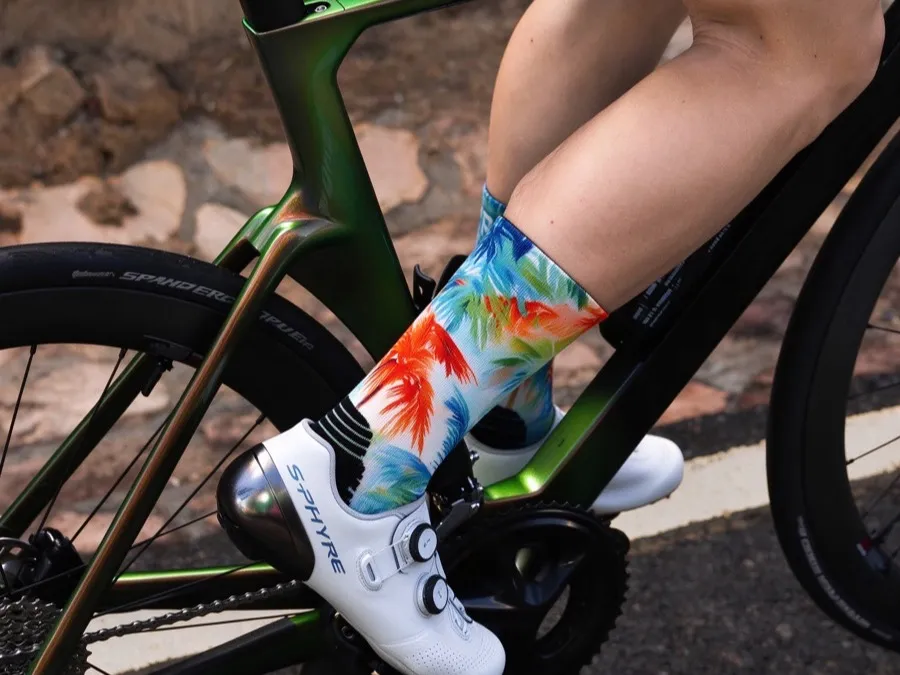
Many online sellers start selling print on demand socks through a fulfillment platform. You upload designs, connect your store, and the supplier prints and ships each order. It’s a low-risk way to start.
As a store grows, a new question comes up: should you keep outsourcing, or bring sock printing in-house? Both models can work. This guide compares them so you can decide what fits your business now and later.
Model 1: Outsourced POD
How it works
You list products on your store or marketplace. When a customer orders, the order goes to a POD supplier, who prints, packs, and ships it.
Advantages
- Low startup cost, with no equipment to buy
- No inventory, since products are made per order
- Easy to test ideas with new designs and niches
- Simple operations, because the supplier handles production and shipping
Limitations
- Lower margins, since the supplier’s price includes their production and profit
- Less control over blanks, print quality, and packaging
- Shared capacity: in busy seasons, your orders wait in line with everyone else’s
- Limited customization: product options and finishing are set by the supplier
- Branding limits: custom packaging and inserts may cost extra or not be possible
Model 2: In-House Printing
How it works
You buy a 360° sock printer and the supporting equipment, stock blanks, and print orders yourself. You can still sell on the same online platforms.
Advantages
- More control over blanks, colors, quality, and packaging
- Potentially better margins once volume justifies the investment
- Faster response: you decide what gets printed first
- Unique products: choose materials, sock styles, and accessories others don’t offer
- New revenue: offer B2B services like team, corporate, and event orders
Limitations
- Upfront investment in equipment, space, and setup
- Operational work: staff, maintenance, and quality control
- Learning curve: materials, inks, pretreatment, and finishing take time to master
- Inventory of blanks: you need to manage stock of sock blanks
Signs It May Be Time to Bring Production In-House
- Your sock orders are steady and growing.
- Supplier delays are hurting reviews during peak seasons.
- Customers ask for blanks, colors, or materials your supplier doesn’t offer.
- You want to sell matching products like sweatbands, arm sleeves, or headwear.
- You’re getting B2B requests for team or corporate socks.
- You want your packaging and quality to reflect your brand.
A Hybrid Approach
You don’t have to switch everything at once. Many sellers:
- Bring best-selling designs in-house first.
- Keep outsourcing slower or experimental products.
- Use in-house capacity for B2B and rush orders.
- Expand in-house production as they learn.
Choosing Equipment for In-House POD
Your equipment should match your stage:
- Starting out or limited space: the compact CO80-600DK desktop sock printer, suited to studios and personalized orders
- Growing order volume: the CO60-100PRO, with twin alternating rollers to keep work moving
- Steady, high demand: the CO80-210PRO, with four rollers in rotation
- Socks plus headwear and frequent style changes: the CO70-220PRO, with an open single-arm design
For planning, reference output is 20–30 pairs/hour for the CO80-600DK and CO70-220PRO, 40–65 pairs/hour for the CO60-100PRO, and 50–120 pairs/hour for the CO80-210PRO. Reference output varies with print mode, artwork, material, workflow and configuration. Full specifications: Colorido sock printer lineup.
Remember to budget for the full workflow: heat-setting equipment, plus pretreatment and finishing setups if you print natural fibers.
Operational Tips for In-House POD
- Automate order intake. Connect your store so print files are organized by order.
- Standardize file preparation. Use templates for each product and size.
- Batch by material. Group polyester and cotton orders to simplify ink and finishing.
- Set clear quality checks before packing.
- Keep a maintenance routine, so your sock printer stays reliable through peak periods.
Cost Thinking (Without the Guesswork)
Every business’s numbers are different. To compare models, list:
- Your current cost per pair from your POD supplier
- Your expected in-house costs per pair: blanks, ink, consumables, labor, and packaging
- Equipment investment and space costs
- Your current and projected monthly volume
Then estimate how long it would take for savings and new revenue (like B2B orders) to cover the investment. Talk with equipment suppliers for real quotes rather than relying on estimates.
FAQ
Can I still sell on Etsy or Shopify if I print in-house?
Yes. In-house printing changes who makes the product, not where you sell it. Check each platform’s production disclosure rules.
Is in-house printing hard to learn?
There’s a learning curve around materials, inks, and finishing, but training and consistent processes help.
Should I switch all products at once?
A gradual, hybrid approach reduces risk.
What else can I print besides socks?
Many sock printers also handle wrist sweatbands and cooling arm sleeves, and some models suit headwear.
Build the Model That Fits
Outsourced POD is a great way to start, and in-house printing is a strong way to grow. Many successful stores use both. Explore product ideas on our custom printed socks page.
Leave A Comment