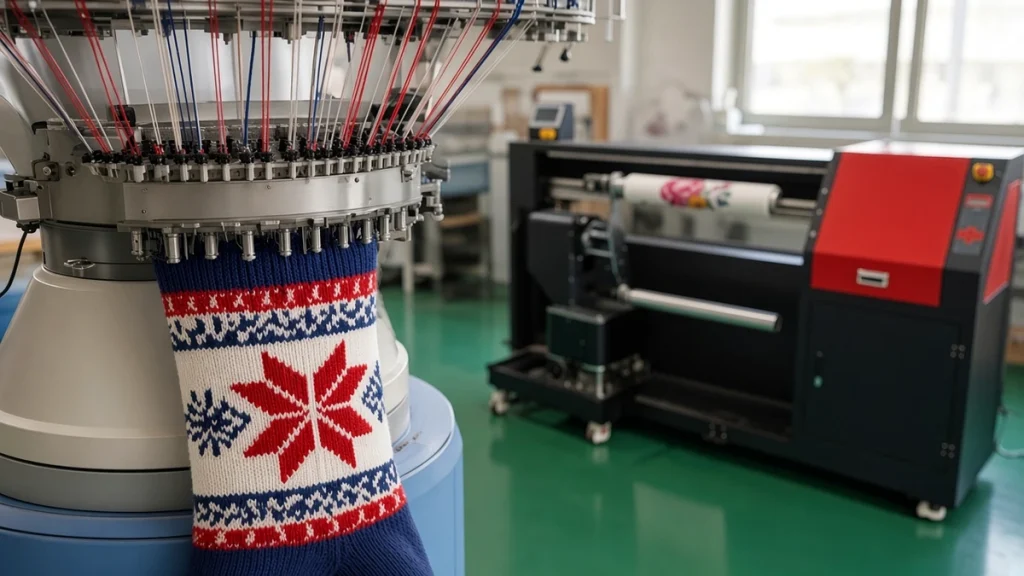
There are two fundamentally different ways to put a pattern on a sock. Jacquard knitting creates the pattern from colored yarns as the sock is knitted. A digital socks printer prints the pattern onto a finished white sock. Both produce attractive socks, and both have clear strengths. Understanding the differences helps brands choose the right method for each product.
How jacquard knitting works
A knitting machine switches between yarn colors to build the pattern stitch by stitch. The pattern is part of the fabric structure. Each design requires a knitting program and the right yarn colors loaded on the machine.
How a digital socks printer works
A blank sock is mounted on a roller and printed with inkjet heads as it rotates. The dye penetrates the fiber, and the pattern wraps seamlessly around the sock. See how a socks printer works.
Comparison
Detail. Jacquard is limited by stitch resolution; fine detail and photographs are not possible. Digital printing reproduces photos, gradients and fine lines.
Colors. Jacquard is limited to the number of yarn feeders, typically a handful of colors per design. Digital printing offers full color.
Minimum orders. Jacquard requires setup per design, so minimums are common. Digital printing works from one pair.
Lead time. Jacquard needs programming, yarn sourcing and sampling. Digital printing can sample in days.
Feel and texture. Jacquard creates a textured, premium knit with floats on the inside. Digital printing keeps the sock's base texture with a smooth inside.
Durability. Both are durable; jacquard colors are inherent to yarn, while properly fixed digital prints resist washing well.
Cost at scale. For very large runs of simple patterns, jacquard can be economical. For varied designs and smaller runs, digital printing usually wins.
When to choose jacquard
- Classic patterns like argyle, stripes and simple logos.
- Very large volumes of a few designs.
- Products where knit texture is part of the appeal.
Our article on jacquard socks vs digitally printed socks explores this further.
When to choose a digital socks printer
- Photographic, illustrative or gradient designs.
- Many designs in small quantities.
- Personalization and print on demand.
- Fast sampling and trend-driven releases.
Combining both
Many factories and brands use both: knitted blanks with jacquard cuffs or logos, then digital printing on the leg and foot. This combines brand identity in the knit with unlimited creativity in the print. See adding a socks printer to a traditional sock factory.
Equipment considerations
Factories with knitting machines already have blank production. Adding a digital socks printer requires printing equipment, fixation and, for cotton, washing and drying. The pretreatment and finishing range supports this integration.
Cost and lead time in practice
Jacquard knitting typically involves programming, yarn selection and sampling for each new design, which suits larger runs where setup is spread across many pairs. A digital socks printer prints designs onto plain blanks, so a new design mainly means a new file and a test print. That difference shapes how each method fits into a business.
When each method fits
- Choose knitting for classic, textured patterns, logos built into the fabric and large repeat orders of the same design.
- Choose digital printing for photographs, gradients, many colors, personalization and short runs.
- Combine both by knitting a branded cuff or base color and printing the main design.
Feel and appearance
Knitted patterns create texture and may show floats of yarn on the inside. Printed socks keep the surface smooth, with color in the fiber rather than in separate yarns. Customers may prefer either, depending on the product.
Sampling
Digital printing makes samples quick, which helps when buyers want to see several options. Knitted samples usually take longer because the pattern has to be programmed and knitted. See fast sampling with a socks printer.
Design freedom
Jacquard designs are limited by the number of yarn colors and the knitting structure. Digital printing allows almost any artwork, but fine details can be affected by stretch.
Making the choice
Look at your design styles, typical order sizes and customer expectations. Many factories run both methods. Read jacquard socks vs digitally printed socks, from jacquard socks to digital print and adding a socks printer to a traditional sock factory. Compare equipment on the socks printer page.
Frequently asked questions
Is digital printing replacing jacquard?
No; they serve different needs. Digital printing is growing fastest in custom and short-run segments.
Can a printed sock look like jacquard?
A print can imitate a knit pattern visually but will not have the same texture.
Which is better for gifts?
Personalized gifts usually need digital printing because each pair is different.
Is a printed sock less durable than a knitted pattern? Correctly fixed dye prints are durable, but knitted patterns are part of the yarn itself. Test both with your care instructions.
Conclusion
Jacquard knitting excels at classic patterns and large runs with texture; a digital socks printer excels at detail, color, personalization and speed. Many successful businesses use both. Explore our digital socks printer models or contact us for advice on combining methods.
Leave A Comment