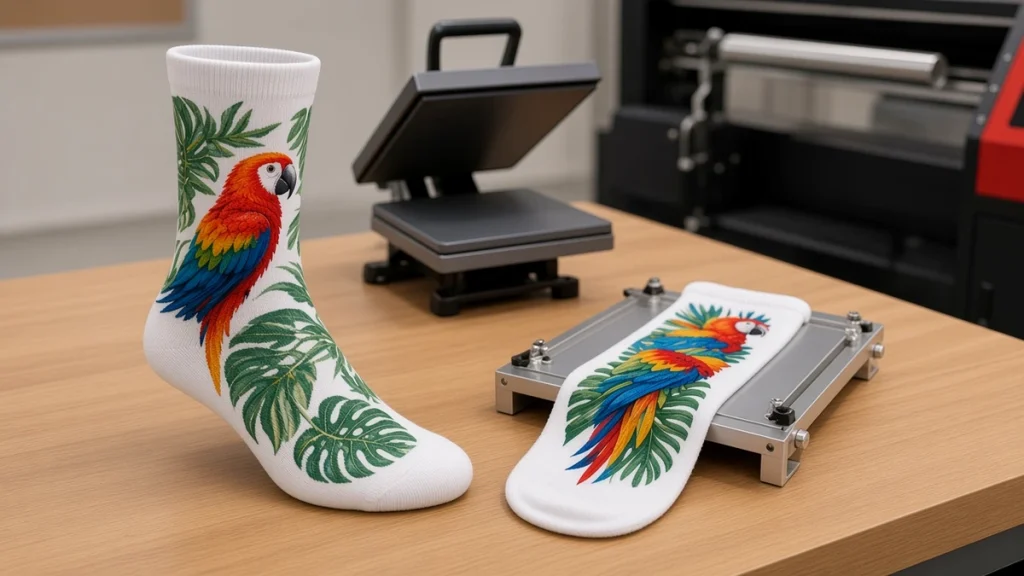
Many sock businesses start with a heat press and sock-shaped jigs. It is affordable and easy to learn. As orders grow, owners begin to ask whether a dedicated sock printing machine would be better. This comparison explains the trade-offs so you can decide when to switch.
How heat press jigs work
A polyester sock is stretched over a flat jig. Sublimation transfer paper is placed on each side, and a heat press transfers the design. Some setups use double-sided presses or rotating jigs.
How a rotary sock printing machine works
The sock is pulled over a roller and printed directly by inkjet heads as it rotates. The print is then heat-fixed in an oven (polyester) or steam-fixed and washed (cotton). See what is a socks printer.
Quality
Heat press: risk of pale side lines where the sock folds over the jig edges; potential ghosting if paper shifts.
Sock printing machine: seamless 360° coverage with no side lines.
Fibers
Heat press: polyester only.
Sock printing machine: polyester, and with the right ink and finishing, cotton and other fibers.
Labor
Heat press: printing paper, cutting, positioning, pressing, peeling for each pair.
Sock printing machine: load, print, unload; multi-roller machines overlap loading and printing.
Materials and waste
Heat press: transfer paper and protective sheets per pair.
Sock printing machine: no paper; ink used directly on the sock.
Start-up cost
Heat press: low.
Sock printing machine: higher, plus fixation equipment.
Scalability
Heat press: limited by manual handling; adding output means adding presses and staff.
Sock printing machine: output increases with roller count and machine choice; see four-roller vs twin-roller.
When to stay with heat press
- Very low volume.
- Testing a market.
- Designs that hide side lines.
When to move to a sock printing machine
- Customers ask for seamless prints.
- Labor is becoming a bottleneck.
- You want to offer cotton.
- You need consistent quality across staff.
Read the related comparison socks printer vs sublimation transfer.
Making the transition
Adapt templates to roller widths, add a heat-fixation oven such as the COHE-150 or a chain oven, and train staff on loading and maintenance. Keep the heat press for occasional special jobs if useful.
Cost comparison over a year
A heat press setup looks cheaper on day one, but costs accumulate with volume: transfer paper for every pair, protective sheets, and especially labor for cutting, positioning and peeling. Over a year of steady orders, labor is often the largest cost. A sock printing machine shifts cost toward equipment and ink but removes paper and much of the manual handling. Businesses printing a few pairs a week may never reach the crossover point; businesses printing dozens or hundreds per day usually do.
Quality consistency between operators
Heat press results depend heavily on the operator: paper alignment, pressure, time and jig placement all vary. A rotary machine standardizes most of these variables in software and mechanics, so different operators produce more consistent results once loading technique is trained.
Keeping both
Some businesses keep a heat press after moving to rotary printing, using it for special projects or flat items. That is perfectly reasonable. The key is to move core sock production to the method that gives customers the best product and keeps your costs predictable. See socks printer ROI for a structured comparison.
Side-by-side test you can run
The fairest comparison is a practical one. Choose one design and one blank, then produce a small batch with each method. Time every step, from file preparation to packed pair, and note material used. Wash-test both batches and compare the seam area, color strength and hand feel. Show the results to a few customers and ask which they prefer. This test answers most questions about whether a sock printing machine is worth it for your business, using your own numbers instead of assumptions.
Questions to consider
- How many pairs do you decorate per week now, and next year?
- How much of the heat press process is manual labor?
- Do customers complain about seam lines or stiff print areas?
- Do you need cotton printing, which transfer methods do not handle well?
See socks printer vs sublimation transfer and rotary socks printer vs flatbed printing.
Record the results so you can repeat the comparison later as volumes change.
Frequently asked questions
Is print quality sharper on a sock printing machine?
Both can be sharp; the main difference is seamless coverage and consistency.
Do I still need heat with a rotary machine?
Yes, polyester prints are heat-fixed in an oven after printing.
Can a heat press print cotton?
Not with sublimation. Cotton needs reactive ink and a different process.
Conclusion
Heat press jigs are a low-cost start; a sock printing machine delivers seamless quality, broader fiber options and better scalability. Switch when quality expectations or volume outgrow the press. Explore the socks printer range or contact us to plan the transition.
Leave A Comment