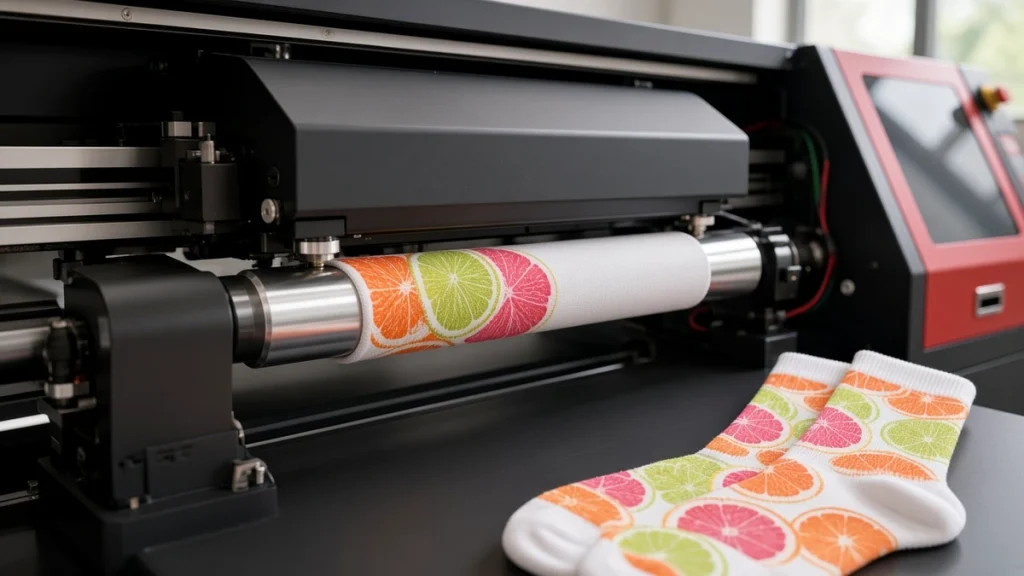
If you have ever seen a pair of socks covered edge to edge in a photo-quality pattern with no visible seam down the side, there is a good chance it came off a socks printer. The machine has quietly changed how custom socks are made, and it is now one of the most practical ways for brands, sock factories and print shops to offer personalized products without large minimum orders.
This guide explains what a socks printer is, how it differs from other decoration methods, and what you need to think about before adding one to your business.
The short definition
A socks printer is a digital inkjet machine that prints artwork directly onto ready-made socks. Instead of printing on flat fabric and then sewing it into a sock, the blank sock is pulled over a cylindrical roller. The roller rotates while the printhead carriage moves along its length, so ink is laid down around the whole tube. The result is a seamless, wraparound print, which is why the process is often called 360 sock printing.
Because everything starts from a digital file, there are no screens, plates or knitting programs to prepare. You can print one pair or several hundred from the same workflow.
The main parts of the machine
Although configurations vary, most machines share the same building blocks:
- Rollers. Aluminium or composite tubes that hold the sock. Roller diameter needs to match the sock size so the fabric is stretched evenly.
- Printheads and carriage. Industrial inkjet printheads mounted on a carriage that travels along the roller. Ningbo Colorido machines, for example, use Epson I1600 printheads on most sock models.
- Ink system. Bulk ink tanks, dampers and tubes that feed the heads. The ink type depends on the fiber you print.
- Control software and RIP. Software that turns your artwork into printhead instructions, manages color and controls rotation speed.
Multi-roller designs such as the CO80-210PRO four-roller socks printer let an operator load and unload socks while another roller is printing, which keeps the machine busy.
What happens after printing
Printing is only one step. The ink has to be fixed into the fiber so the colors survive wearing and washing. Polyester socks printed with disperse ink are heat-fixed in an oven; cotton socks printed with reactive ink are steamed or fixed at a lower temperature, then washed and dried. That is why most buyers plan a complete line that includes pretreatment and finishing equipment alongside the printer.
What can a socks printer print?
The obvious answer is socks of every length, from ankle socks to knee-highs. But any tubular, stretchable product that fits on a roller is a candidate. Depending on the model and roller set, the same machine family can handle ice sleeves, arm sleeves, beanies, neck gaiters, wristbands and even seamless yoga wear. Our article on what else a socks printer can print covers these applications in more detail.
Who uses a socks printer?
The technology suits several very different businesses:
- Custom sock brands that want to own production instead of waiting on overseas minimums.
- Traditional sock factories that knit blanks and want to add printed lines without new knitting programs.
- Print-on-demand sellers who receive single orders from online stores and need a fast, file-driven process.
- Promotional product companies that make branded socks for events, teams and corporate gifts.
Each of these groups values something slightly different. A factory may care most about throughput; an online seller cares about flexibility and quick changeovers; a promo company cares about turning samples around before a client meeting.
Socks printer versus other methods
Before digital machines, printed socks were usually made with sublimation transfer paper pressed onto a flattened sock, or with screen printing. Both have their place, but both leave visible limits. Pressing a flattened sock tends to leave white side lines where the fabric folds, and screen printing needs a separate screen for each color, which makes short runs expensive. A socks printer avoids both problems by printing the tube in the round. We compare these options side by side in socks printer vs screen printing.
Jacquard knitting is another alternative. It creates the pattern from colored yarns, which looks premium but limits the number of colors and the level of detail. Digital printing can reproduce gradients and photographs that knitting simply cannot.
Questions to ask before you buy
If you are considering your first machine, start with your production plan rather than the spec sheet:
- Which fibers will you print most often: polyester, cotton or blends?
- How many pairs per day do you expect in the first year, and in year three?
- Will one operator run the machine, or will you staff it in shifts?
- Do you have the floor space and power for ovens, steamers and dryers?
- Who will support you when something goes wrong?
Answering these questions will point you toward the right configuration, whether that is a compact desktop model or a multi-roller production machine. Our socks printer buying checklist walks through the full list.
The bottom line
A socks printer turns a digital design into a finished, wraparound printed sock without screens or minimum orders. It is not a single machine purchase so much as the heart of a small production line, together with the right inks, fixation equipment and training. Get those pieces right and you can offer custom, short-run and personalized socks profitably.
If you want to see how the different configurations compare, browse the Ningbo Colorido socks printer range or contact our team for a recommendation based on your products and output goals.
Leave A Comment