A short video of a rotary sock printer can show movement, print detail and loading technique. It cannot, by itself, tell you how many finished pairs your business can release in a working day. Before choosing a socks printing machine, ask for a documented output test built around your products—not only a demonstration of the fastest print mode.
The useful question is simple: how many complete pairs meet your agreed quality requirements, and what work remains after printing? This guide provides a practical test record for equipment buyers. It complements our sock printer buying checklist rather than replacing a full technical discussion.
1. Define what the test must prove
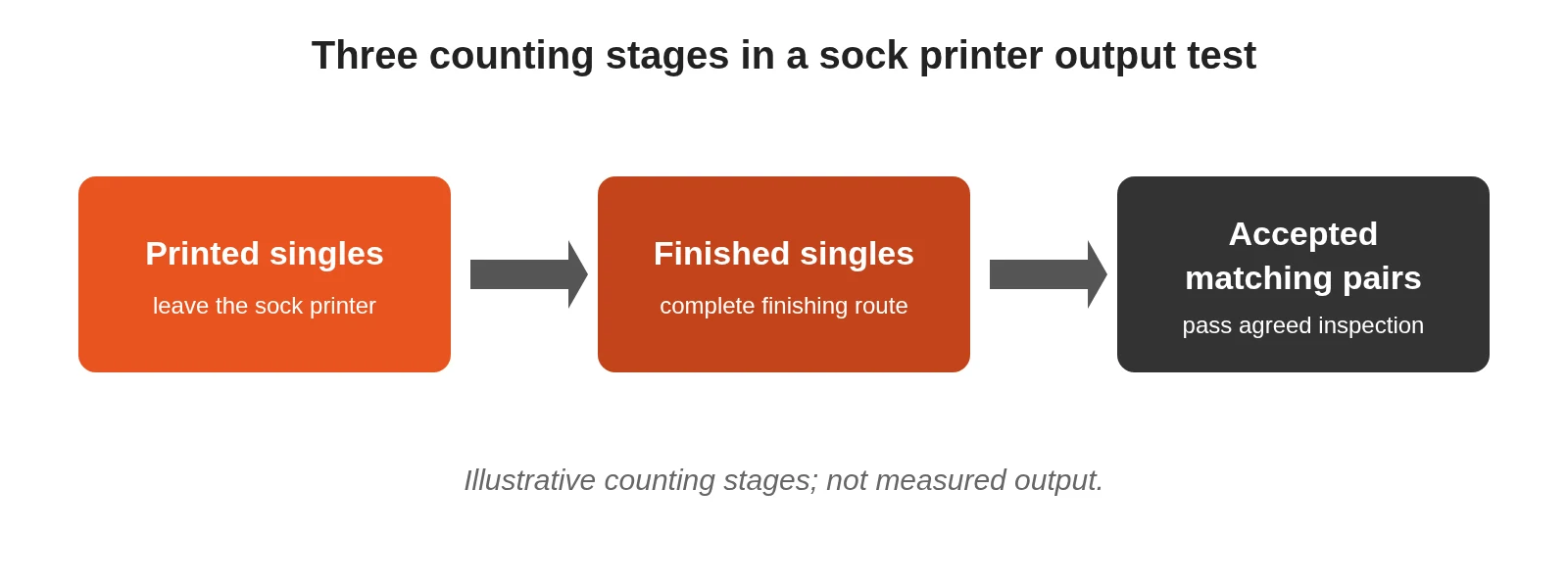
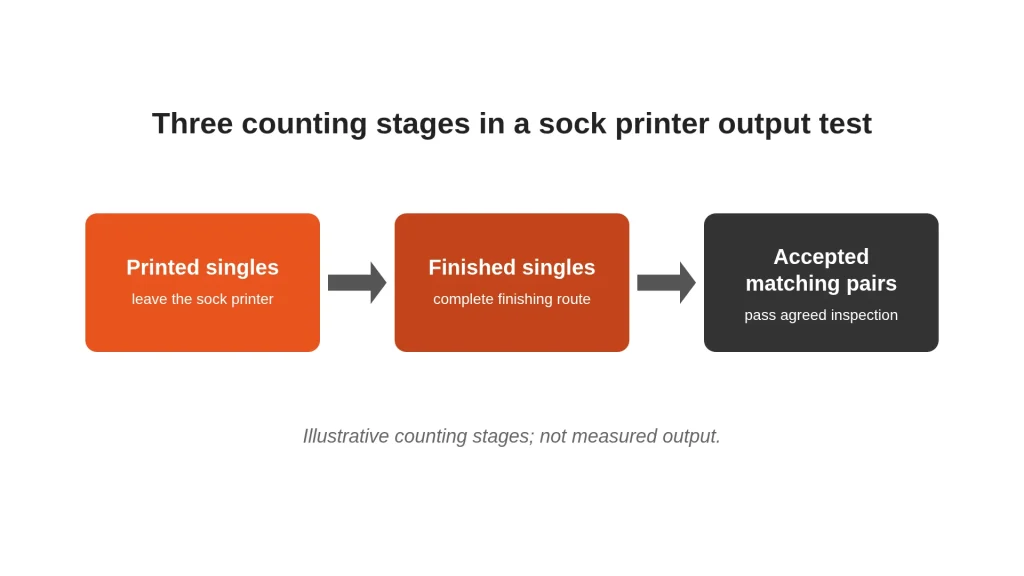
Separate three measurements before the demonstration:
- Printing-stage output: socks leaving the sock printer during the measured interval.
- Finished output: socks that have completed the material-specific finishing route.
- Accepted output: complete pairs that pass the agreed inspection after finishing.
These quantities are not interchangeable. A printed sock may still need fixation or other processing. Two acceptable single socks are not a saleable pair if their size or artwork does not match.
Agree whether the trial measures the sock printer alone or the complete production route. If finishing happens later, keep that result separate; do not label print-stage output as finished-pair capacity.
2. Bring a representative test pack
Send the supplier blanks and artwork that reflect the orders you expect to make. Include your main sock size and a second commercially important size if size changes are part of normal work. Record the declared fiber composition, blank supplier, lot reference and dimensions.
Use a design with realistic coverage. A small emblem on a light background is not an adequate stand-in for a dense all-over pattern. Include details that matter to your buyers: a gradient, fine lettering, or an image with recognizable edges. Avoid adding artificial complexity that you do not actually sell.
Keep the source file and its version fixed throughout the comparison. If the supplier changes a profile or print mode, start a separately labeled run instead of combining the results.
3. Agree the clock and the counting rules
Record setup separately from the timed run. State whether the interval starts with blanks ready to load, artwork already processed, and the machine prepared for printing. Those conditions make comparison possible, but they are not the same as starting a new shift from cold equipment.
During the run, log loading, unloading, pauses, cleaning and any reprints. Record the actual staffing used without assuming that the same arrangement will suit every workshop. If a size or artwork change is part of the test, identify its start and finish rather than hiding the interruption.
Use a continuous record where practical. A highlight reel is useful marketing material, not a substitute for a run log. Agree the trial duration with the supplier so it represents your intended operating pattern; there is no universal duration that proves every production claim.
4. Follow the socks through finishing
The finishing route depends on the fiber, ink system and validated process. Do not assume that every digitally printed sock uses the same oven treatment, or that heat alone replaces all other steps.
Ask the supplier to identify which equipment and processing stages are required for your blanks. Track the test batch through that route, recording waiting time as well as processing time. For context, read our digital sock printing line overview.
If the trial uses finishing equipment different from the proposed purchase package, note that difference explicitly. A demonstration supported by a larger finishing line cannot establish the output of a smaller proposed line without further validation.
Do not invent a faster temperature-and-time recipe to make equipment capacities match. Request a validated process recommendation for the actual material and ink combination.
5. Inspect and pair before calculating results
Agree acceptance criteria before seeing the results. Check artwork orientation, wrap continuity, visible defects, consistency between paired socks and appearance at representative wearing stretch. Compare finished goods with an agreed physical reference, not only a bright screen image.
Separate clearly defective items from items awaiting review. Record the reason for each rejection or reprint. A wash check may be part of the agreed evaluation, but a quick visual test does not establish a certified durability rating.
Use this simple record:
| Field | What to enter |
|---|---|
| Run identity | Date, model, blank lot, size and artwork version |
| Configuration | Ink system, profile, print mode and roller used |
| Test boundary | Printing only or complete finishing route |
| Time | Setup, timed run, interruptions and finishing completion |
| Quantities | Printed singles, finished singles, accepted matching pairs |
| Exceptions | Reprints, rejected pieces and unresolved quality checks |
Calculate accepted pairs per elapsed hour only for a clearly defined observation window. State whether it includes setup and finishing. For a batch processed in stages, report batch completion time alongside print-stage output rather than pretending every station ran continuously together.
6. Turn the findings into a purchase discussion
Compare suppliers using the same blanks, artwork, quality target and timing boundary wherever possible. If those conditions differ, explain the difference instead of ranking machines by one headline figure.
Ask for a written configuration proposal linked to the test: sock printer model, compatible rollers, ink route, required finishing equipment and training scope. Save the test record and retained samples as references for follow-up discussions.
To discuss a trial, start with the Colorido sock printer range and send your blank specification, artwork, size mix and target accepted-pair output. If you want finished products rather than equipment, use our custom printed socks service instead. The right enquiry starts by distinguishing the machine you want to buy from the socks you want to order.
Frequently Asked Questions
What does a sock printer output test measure?
It measures output under stated conditions using identified blanks, artwork and settings. Printing-stage output and accepted finished-pair output should be recorded separately.
Should I use my own blank socks?
Yes, where practical. Your intended production blanks make the result more relevant. Record the fiber composition, size and lot so later trials can be compared.
Does a faster print mode guarantee more finished pairs?
No. Loading, interruptions, finishing and rejected items can limit accepted output. Compare results at the quality level your products actually require.
Must every printed sock go through the same oven process?
No. The required finishing route depends on the fiber and ink system. Confirm the validated stages and equipment for your actual blanks before purchasing.
Can I compare two machines using different designs?
Only with clear limitations. Coverage, detail and size can change the workload. A shared test pack makes a comparison more meaningful.
What should I send when requesting a production test?
Send blank specifications, sizes, representative artwork and your target accepted-pair output. Ask the supplier to document the configuration, timing boundary and finishing route.
Leave A Comment