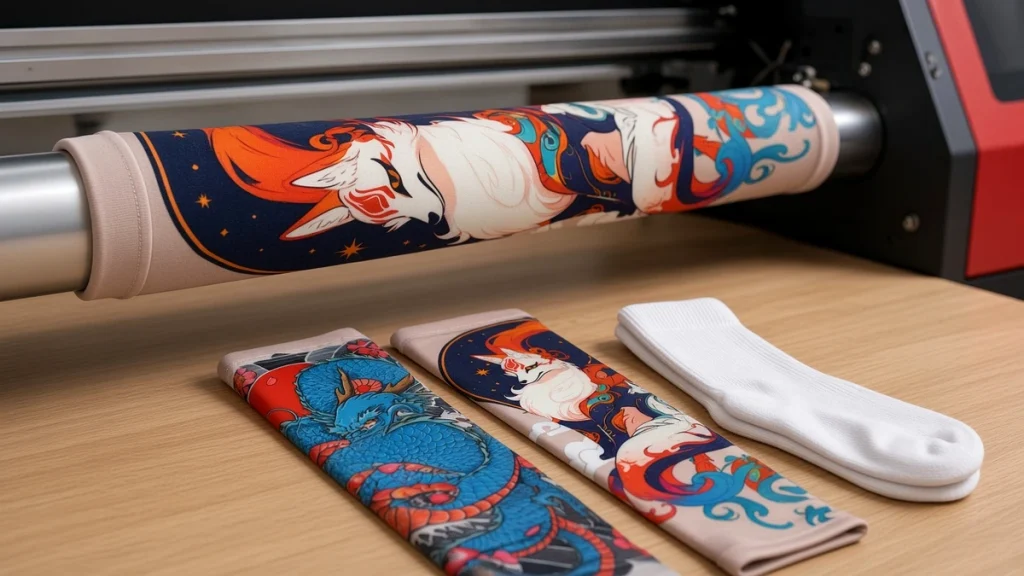
Ice sleeves, also called cooling arm sleeves, are popular with cyclists, golfers, anglers, drivers and outdoor workers. They protect arms from sun and feel cool in hot weather. Because they are stretchy tubes, they print beautifully on a rotary socks printer, making them an excellent product to add alongside socks.
Why ice sleeves suit rotary printing
- Tubular shape fits on a roller like a long sock.
- Polyester-rich fabrics take disperse ink brilliantly.
- All-over designs look striking on arms.
- Short polyester workflow: print, heat-fix, pack.
Materials
Most ice sleeves use polyester or nylon blends with elastane for stretch. For disperse ink, high polyester content gives the most vivid results. Test blanks before production.
Rollers and print length
Ice sleeves are longer and sometimes wider than socks. Check:
- Roller diameter suits the sleeve circumference.
- Machine print length covers the sleeve length.
Twin-roller machines with longer print lengths, such as the CO60-100PRO, handle sleeves well. See 360 sock printer rollers.
Design ideas
- Bold animals: dragons, tigers, eagles, horses.
- Camouflage and outdoor patterns.
- Team colors and logos.
- Fish and fishing themes.
- Abstract and geometric patterns.
See examples in our gallery, such as the dragon ice sleeve and fox ice sleeve designs.
Design tips
- Sleeves taper from upper arm to wrist; account for different stretch along the length.
- Place focal elements on the outer forearm.
- Ensure seamless joins around the circumference.
Fixation
Use the same heat-fixation oven as for polyester socks. Chain ovens such as the COHE-1801 handle sleeves alongside socks.
Selling ice sleeves
- Summer products that balance winter-heavy sock sales.
- Bundle with matching socks for teams and clubs.
- Target outdoor communities: golf, cycling, fishing, motorcycling.
- Offer personalization with names or club logos.
If you plan to sell sleeves alongside wrist sweatbands, see custom printed cooling arm sleeves and wrist sweatbands for buyer groups and matching-set ideas.
Pricing and positioning ice sleeves
Ice sleeves sit in an interesting price range. Plain sleeves are inexpensive commodity items, but printed designs, team logos and personalized names command noticeably higher prices because they are perceived as gear rather than basics. Position your sleeves as part of a look: matching socks and sleeves for a cycling club, or a golf set with a club logo, sells better than a sleeve alone.
Quality checks specific to sleeves
Sleeves have features that socks do not, so add a few checks to your inspection routine:
- Gripper bands: many sleeves have silicone or elastic grippers at the top. Make sure the design does not look cut off where the band begins.
- Taper: confirm the design is not visibly distorted between the upper arm and wrist.
- Pairs: check that left and right sleeves match, or mirror correctly if designed that way.
- Finish: confirm the fabric still feels smooth and cool after fixation.
Seasonal planning
Demand for ice sleeves rises ahead of warm weather and outdoor sports seasons. Prepare designs and blanks in advance, and use the sleeve season to keep your printer busy when sock demand is quieter. Many sock businesses find that sleeves smooth out their annual workload. See custom socks for sports teams for ideas on combining sleeves with team socks.
Designing for sleeves
Ice and arm sleeves are worn on arms during sports, cycling and outdoor work, so designs are seen from many angles and in motion. Bold patterns, team colors and simple logos work well. Keep important elements away from the ends, where the fabric gathers. Prepare templates for each sleeve size and roller, just as for socks. See examples such as the tiger ice sleeve and dragon ice sleeve pages.
Fiber and fixation
Ice sleeves are often polyester-based blends chosen for cooling and stretch. Test each blank for color results and comfort, and confirm fixation settings, since thinner fabrics can react differently to heat than socks.
Selling opportunities
Sleeves pair naturally with team socks, cycling clubs and outdoor workwear. Offer matching sets to raise order value. See custom socks for sports teams and what else can a socks printer print.
Quality checks for sleeves
Check both ends for consistent coverage, inspect the seam line where the print meets, and stretch sleeves gently to confirm the design holds up. Wash-test a few samples from each new blank batch before selling. Ask riders or players for feedback on comfort and fit; their comments help you choose better blanks and designs for the next order.
Frequently asked questions
Do printed ice sleeves keep their cooling effect?
Cooling depends on fabric construction; dye-based printing does not add a heavy surface layer, so the fabric feel is largely preserved.
Can I print on nylon sleeves?
Nylon generally needs acid ink rather than disperse; check fiber and ink compatibility.
Are sleeves sold in pairs?
Usually yes; print mirrored or identical designs.
Conclusion
Ice sleeves are an easy, profitable extension for a rotary socks printer: same equipment, same polyester workflow, new customers and seasonal balance. Explore our applications gallery for sleeve designs or contact us about rollers for your products.
Leave A Comment