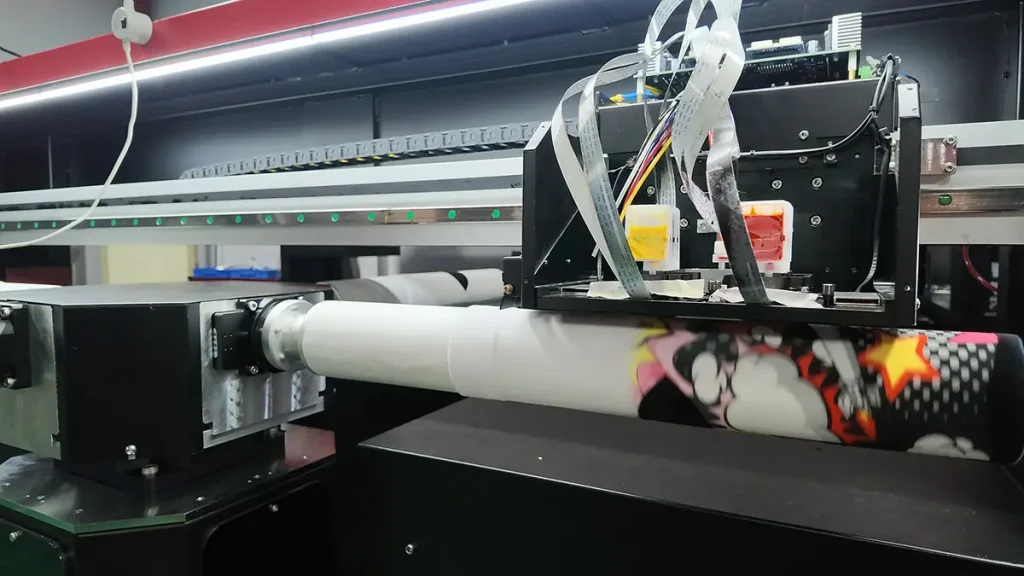
Every sock factory reaches the same crossroads sooner or later: a buyer sends artwork with a gradient fade, a photo-real character, six colors and a request for 800 pairs — and the screen printing line that has served you for a decade suddenly cannot answer the question profitably.
For years the answer was simple. If the volume was high enough, screen printing on socks beat everything on unit cost. That logic has not disappeared, but the order book around it has changed. Buyers now work in smaller drops, wider SKU counts and shorter lead times, and they expect decoration quality that used to belong to apparel, not to a pair of socks that has to retail at a competitive price.
Digital sock printing was built for exactly that gap. But “digital is better” is a supplier’s pitch, not a purchasing decision. The real question is narrower and more useful: at what order size, and for what kind of design, does each process actually win — and how should a factory configure its line so that neither process sits idle?
This guide answers that with the mechanics, the cost structure and the decision rules, so you can map the answer onto your own order book rather than someone else’s brochure.
The short answer
| Your situation | Better fit |
|---|---|
| Many small orders, frequent design changes, e-commerce / POD buyers | Digital sock printing |
| Gradients, photo-real artwork, unlimited colors, fine line detail | Digital sock printing |
| Full 360° wrap coverage across the whole sock body | Digital with rotary fixture |
| Sampling and pre-production approval for every design | Digital sock printing |
| One or two best-selling designs, pure solid colors, very large runs | Screen printing (flat screen) |
| Single-color logo bands on high-volume basics | Screen printing, or knit-in jacquard |
| Large solid white or metallic coverage on dark fabric | Screen printing |
| You already hold a screen room and a trained operator team | Keep it, and add digital for the small end |
Most factories that stay competitive end up running both. The rest of this article explains why, and where the dividing line sits.
How screen printing on socks actually works
Screen printing on socks is a flat-screen process, not a rotary textile process. The sock is loaded onto a board or a shaped former so the surface to be printed is flat and stable. A mesh screen is prepared for each color — coated with emulsion, exposed, developed and cured — and the paste is pushed through the open areas with a squeegee.
Key characteristics that follow from the mechanics:
- One screen per color. A four-color design needs four screens, four exposures and four registration steps. A six-color design doubles the setup work again.
- Setup is front-loaded. The screens are a fixed cost per design per color. Once they exist, the marginal cost of printing pair number 20,000 is low.
- Registration is manual-intensive. Each color must land exactly on the previous one, on a curved, stretchy substrate that moves every time it is loaded. Skilled hands matter more than the machine.
- Coverage is limited by the board. You can print a flat panel well, and you can print the sole and heel areas with dedicated formers, but a continuous wrap that runs unbroken around the leg and foot is not what a flat screen is designed to do.
- Paste is cheap per gram. Plastisol, water-based or silicone inks cost a fraction of what digital ink costs per square meter, which is why high volume favors this route.
How digital sock printing actually works
Digital direct-to-sock printing removes the screen entirely. Artwork goes from a file to a printhead. The sock is mounted on a rotary or tubular fixture, the printhead traverses, and the fixture indexes to present the next section of the tube — which is how a single pass can produce continuous 360° coverage on the leg, heel and foot without a seam at the join.
The process has four real steps, and buyers who skip the last two usually end up disappointed with wash fastness:
- Pretreatment. A pretreatment liquid is applied to the print area, then dried and pressed. It controls ink bleeding on the fiber, keeps the dots crisp and helps pigment sit on the surface instead of sinking in.
- Printing. An industrial piezo printhead deposits ink on demand. Because there is no screen, the number of colors in the file has no effect on cost or setup time.
- Curing / fixation. Pigment inks are fixed with heat — a tunnel oven, a heat press or an ironing calender depending on the line. Reactive and disperse routes have their own fixation requirements.
- Washing and drying. Reactive inks must be steamed and washed to remove unfixed dye and hit fastness targets. Pigment inks on a well-pretreated surface are usually wash-free, which is one reason pigment has become the default for sock decoration.
Because there is no screen, three things change at once: minimum order quantity collapses, changeover time collapses, and the cost curve changes shape from front-loaded to nearly linear.
A third option worth naming: knit-in jacquard
Buyers often confuse digital printing with jacquard knitting, and the two are quoted differently for a reason. Jacquard builds the pattern into the fabric on the knitting machine using colored yarns. There is no printing step at all.
- Strengths: excellent durability, no print hand feel, no post-treatment, unbeatable for simple geometric patterns and stripe programs at very high volume.
- Limits: pattern resolution is constrained by stitch density, fine gradients and photo-real images are effectively out of reach, and every design change means re-programming and re-knitting, which ties up machine time that could be producing sellable basics.
If a buyer asks for “printed” socks but the artwork is four flat colors inside a repeating band, jacquard may be cheaper than either printing route. Worth checking before you quote.
Head-to-head: the eight dimensions that decide it
1. Minimum order quantity and order flexibility
Screen printing pushes you toward volume because the screens are a sunk cost per design. Below a certain run length, the setup is spread over too few pairs and the unit cost becomes unacceptable — often the reason small buyers are quoted “minimum 3,000 pairs” or are simply turned away.
Digital sock printing has no screen cost, so a realistic MOQ is set by your handling time rather than by amortization. Factories typically quote from a few dozen pairs, and many will print a single pair for approval. That matters commercially: it lets you serve the e-commerce, promotional and POD segments that screen-only factories cannot profitably touch.
2. Design freedom
| Capability | Screen printing | Digital |
|---|---|---|
| Number of colors | Cost scales with colors | No cost impact |
| Gradients and blends | Hard, banding-prone | Native |
| Photo-real and fine detail | Poor | High |
| Full 360° wrap | Limited by board geometry | Standard on rotary fixtures |
| Variable data (names, numbers) | Not viable | Trivial |
| Very large solid white on dark | Strong | Possible, needs white ink layers |
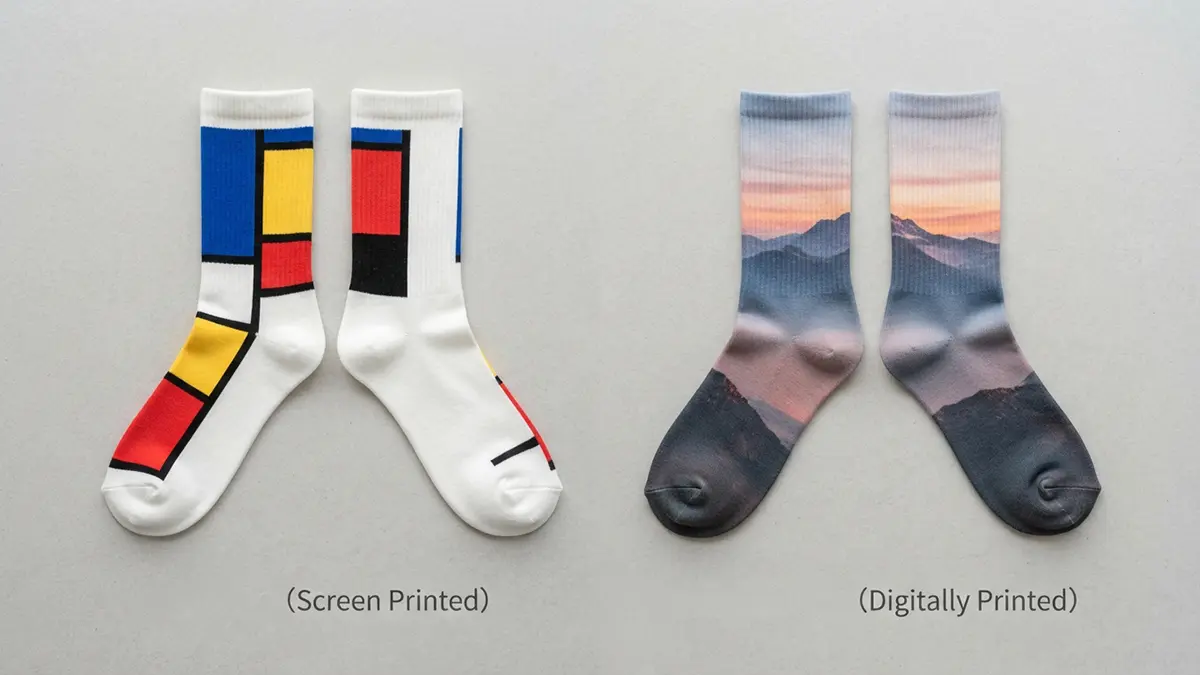
This is usually the decisive column. If your buyers send artwork with fades or licensed characters, the conversation is over before cost is discussed.
3. Changeover time and lead time
A screen setup for a four-color design is a half-day to a multi-day activity depending on color count, screen availability and whether the artwork needs re-separating. Digital changeover is the time it takes to load the next file and re-mount the sock — minutes, not days.
For buyers running seasonal drops or testing designs, this difference in lead time is worth more than the per-pair differential. It is also what makes short re-orders practical: you can reprint 200 pairs of a design you already sold out of, in the same week.
4. Cost per pair — and where the crossover sits
This is where most comparisons go wrong, because they compare only the variable cost. The right way to look at it is fixed cost versus variable cost per design.
- Screen: high fixed cost per design (screens, separation, setup labor, make-ready waste), low variable cost per pair.
- Digital: near-zero fixed cost per design, higher variable cost per pair (ink, pretreatment, print time, fixation energy).
The crossover order quantity is therefore:
N = (Fs − Fd) / (Vd − Vs)
Fs = fixed cost per design on screen (screens + setup + make-ready waste)
Fd = fixed cost per design on digital (normally ≈ 0)
Vd = digital variable cost per pair
Vs = screen variable cost per pair
Worked example with illustrative figures — replace them with your own quotes before publishing:
| Input | Value (illustrative) |
|---|---|
| Fs — 4-color screen set, setup labor, make-ready waste | USD 120 per design |
| Fd — digital setup | USD 0 |
| Vd — digital variable cost per pair | USD 0.55 |
| Vs — screen variable cost per pair | USD 0.38 |
| Crossover N | 120 / (0.55 − 0.38) ≈ 706 pairs |
Below roughly 700 pairs per design, digital is the cheaper route. Above it, screen printing starts to win on direct cost — and keeps winning as volume grows, until the next constraint appears.
That next constraint is inventory. Screen printing only reaches its cost advantage at volumes that force you to print stock you have not sold. Carrying cost, markdown risk and dead stock on a seasonal design frequently erase the per-pair saving. When you price the comparison, add a line for unsold inventory, not just for ink.
5. Hand feel, coverage and wash fastness
- Screen printing lays down a paste layer that can be felt. On large solid areas it can read as stiff, which some buyers accept on promotional socks and reject on premium ones. Wash fastness is excellent when cured properly.
- Digital with pigment ink on a correctly pretreated surface produces a thin, soft deposit and a hand feel close to the base fabric. Fastness is good — but only if pretreatment, curing temperature and time are right. Under-cured pigment is the single most common cause of a “digital printing fades” complaint, and it is a process failure, not a technology limit.
- Digital with reactive ink delivers the best hand feel and fastness on cotton, at the cost of steaming and washing equipment plus wastewater handling.
Ask any supplier for a wash test report on your own fabric, not on their demo sock. Fiber blend, yarn count and dye lot all move the result.
6. Production speed and capacity
Speed comparisons are meaningless without a stated design. A digital machine printing a small chest logo runs several times faster than the same machine printing a dense full-wrap photographic panel, because print time scales with ink coverage area. Screen printing’s rate is roughly flat across designs but carries setup dead time per changeover.
The practical metric for a factory is pairs per paid labor hour across a realistic order mix, not peak throughput on a single easy design.
7. Labor, skill and equipment footprint
Screen printing is a craft process: screen making, emulsion coating, exposure, registration and color matching all depend on trained operators, and a shop that loses its master printer loses capability. Digital is closer to an equipment process — a trained operator loads, prints and unloads, and quality is governed by profile settings rather than hand skill. That makes digital easier to run on a second shift and easier to scale without hiring a specialist.
Footprint differs too: a screen room needs space for screens, racks, washout and paste storage, while digital needs pretreatment, the printer, and fixation equipment.
8. Environmental and compliance load
- Screen: paste inventory, screen washout effluent, solvent handling and disposal costs. Compliance burden scales with the number and type of colors you run.
- Digital: low-volume ink handling, but pretreatment effluent and, for reactive routes, significant washing water. Pigment routes cut water use sharply, which is why they dominate in markets with tight discharge rules.
- Both: buyers in the EU and US increasingly ask for OEKO-TEX ECO PASSPORT on the inks and, for kids’ socks, CPSIA-relevant documentation. Being able to hand over ink and pretreatment certificates shortens the sales cycle more than a price cut does.
Where screen printing still wins
Do not read this as a recommendation to retire your screen room. Screen printing remains the correct answer when:
- The design is one to four flat colors with no gradients, and the run is in the tens of thousands.
- The buyer needs heavy, opaque white or metallic coverage on dark fabric.
- The product is a basic replenishment item with a stable design that sells predictably.
- The order requires a tactile, raised print effect that is part of the design language.
- The factory already has a trained screen team and the amortized screens are effectively free.
Where digital wins
Digital is the correct answer when:
- The order book is fragmented: many buyers, many designs, low quantities each.
- Artwork contains gradients, photography or licensed characters.
- The buyer needs a physical sample or a small pre-production run to sell the design internally.
- The design must wrap continuously around the sock with no seam or bare panel.
- Turnaround time, not unit cost, is the constraint — restocks, drops, tournament merch, event socks.
- The buyer wants variable data: names, squad numbers, dates.
The configuration most factories should target
The productive answer is rarely “replace the screen line”. It is to split the order book:
- Sampling and approval — always digital. It removes the cost of making screens for a design that may not be ordered.
- Small and mid runs, complex artwork, fast turns — digital.
- Large runs of simple, stable designs — screen printing, or jacquard where the pattern suits knitting.
- Overflow and seasonal peaks — whichever route has free capacity; the digital line absorbs peaks without setup cost.
That split keeps the screen room earning on the volume it is good at, and stops it from being the bottleneck that turns small buyers away.
Buying checklist: twelve questions to ask before you commit
- What is the measured output per hour on my artwork, not on a demo file?
- What is the maximum print width and the maximum sock length the fixture accepts?
- Does the rotary fixture print a true continuous wrap, or does it leave a gap at the join?
- Which ink route — pigment, reactive or disperse — and what post-treatment does each require?
- What fastness result can you show on my fabric, tested to which standard?
- What is the real consumable cost per pair: ink, pretreatment, and energy per print?
- How long does a design changeover take, measured with a stopwatch?
- What is the daily and monthly maintenance routine, and which parts are consumables?
- How is print quality controlled — ICC profile, color calibration, nozzle check schedule?
- What is the spare parts lead time, and which parts should I hold in stock?
- What installation, training and remote-support commitment comes with the machine?
- Can I send you my own socks and artwork for a paid sample test before ordering?
Question 12 is the one that separates a supplier from a vendor. A supplier will run your fabric.
FAQ
Can screen printing produce a full 360° wrap on a sock?
Not as a continuous, unbroken print. Flat screen printing works on a sock mounted to a board or former, so coverage is limited by that geometry. Printing the leg, heel and foot as separate panels is possible, but the joins show. A rotary digital fixture prints the tube continuously instead.
Is digital sock printing wash-fast enough for retail?
Yes, when the process is complete. Pigment ink needs correct pretreatment and full curing; reactive ink needs steaming and washing. Most failures attributed to “digital printing” are actually under-cured pigment or missing pretreatment. Always ask for a fastness report on your own fabric to a named standard.
What is the minimum order for digital printing on socks?
Effectively one pair. There is no screen to amortize, so MOQ is set by your handling and fixation batch size, not by setup cost. Most factories quote from a few dozen pairs upward.
Can a digital sock printer print white on dark socks?
Yes, using white ink under the color layers. It requires adequate pretreatment and usually more passes, which lowers throughput and raises cost per pair. If a design is mostly large solid white on black, screen printing is often still the better route.
Do I need a pretreatment machine and a washing line?
Pretreatment is required for pigment printing on socks — it is not optional, and skipping it is the fastest way to blurred edges and poor fastness. A washing line is required for reactive ink; pigment routes on pretreated fabric are normally wash-free.
How long does it take to change a design?
Digital: minutes, because the pattern is a file. Screen: half a day to several days depending on color count and screen making, plus make-ready and registration time.
Next step
If you are currently turning away small orders because the screen setup does not pay for itself, the cheapest way to test the digital route is a sample run on your own fabric. Send us your artwork, your sock specification and your target volume, and we will tell you which process wins on your numbers — including the case where the answer is “keep your screen line for this one”.
→ Request a sample test and quotation | Browse the digital sock printing machine range | Compare models: CO60-100PRO for start-up and small-batch production, CO80-210PRO for high-volume custom sock production.
Leave A Comment