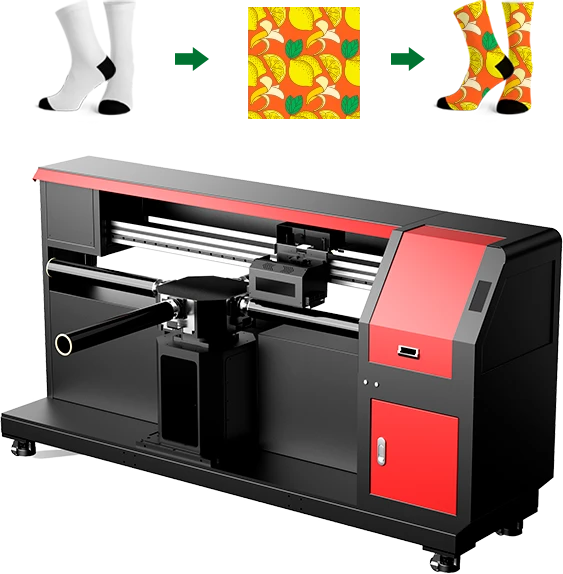
Some businesses try printing socks on flatbed printers they already own, such as direct-to-garment or UV printers, using sock-shaped jigs. Others invest in a rotary socks printer designed specifically for tubes. Both approaches put ink on socks, but the results and economics differ significantly.
How flatbed printing with jigs works
A sock is stretched over a flat jig and placed on the printer bed. The printer prints one side; the sock is flipped to print the other. Ink type depends on the printer: pigment DTG inks, UV-curable inks or others.
How a rotary socks printer works
The sock is pulled over a cylindrical roller that rotates under the printheads, producing seamless coverage around the entire tube. Fiber-specific dye inks are fixed by heat or steam. See rotary socks printer explained.
Coverage
Flatbed: two separate faces with edges at the folds; side lines and alignment issues are common.
Rotary: continuous 360° coverage with no side lines.
Feel and stretch
Flatbed with pigment or UV ink: ink can sit on the surface, potentially feeling stiffer and cracking when stretched.
Rotary with dye inks: dye penetrates fibers, preserving stretch and softness.
Durability
Flatbed: depends on ink and curing; surface inks may wear or crack with stretch.
Rotary: properly fixed dyes are part of the fiber. See digital print socks durability.
Throughput
Flatbed: two print passes per sock plus flipping and jig handling; batch jigs help but alignment remains manual.
Rotary: one continuous print; multi-roller machines overlap loading and printing.
Investment
Flatbed: may use existing equipment, lowering initial cost.
Rotary: dedicated machine plus fixation equipment, but purpose-built for socks.
When flatbed makes sense
- Occasional sock jobs in a shop focused on other products.
- Small logos on one side only.
When rotary makes sense
- Socks are a core product.
- Customers expect seamless all-over designs.
- You need soft hand feel and wash durability.
- Volume justifies dedicated equipment.
Cost per pair comparison
When comparing approaches, look at total cost per finished pair rather than equipment price alone. Flatbed printing with jigs often uses more expensive inks, needs pretreatment for some ink types and requires two print passes plus manual flipping. A rotary socks printer uses dye inks matched to the fiber, prints in a single continuous pass and, on multi-roller machines, overlaps loading with printing. For businesses where socks are a core product, these differences usually favor rotary equipment.
Customer perception
Customers compare products side by side, especially online. A flatbed-printed sock with visible edges at the sides and a slightly stiff print area competes poorly against a soft, seamless rotary print. Return rates and reviews reflect that difference.
A practical path
If you already own a flatbed printer, it can be a reasonable way to test demand for printed socks. Once you see steady orders, move sock production to a rotary machine and keep the flatbed for the products it suits best. Our socks printer buying guide helps you choose the right first rotary machine.
How jigs and rollers handle sock shapes
Flatbed printing needs socks to be flattened on jigs, which works for one side at a time. The sides and back can show unprinted areas or edge marks where the two prints meet. A rotary socks printer pulls the sock over a roller and rotates it under the printheads, so the design wraps continuously. For all-over designs, this difference is clear when customers turn the sock in their hand.
Workflow differences
With flatbed jigs, operators often load several socks, print one side, flip them and print again, aligning carefully. With rotary printing, each sock is loaded once and printed in one pass. Fewer touches usually mean fewer alignment errors and less handling time.
Choosing for your products
Flatbed printing remains useful for flat items such as T-shirts, bags and patches. If socks are a small part of your work, it may be enough. If socks are a core product, rotary equipment usually fits better. See rotary socks printer explained.
Questions to ask before switching
Can I reuse my flatbed designs? Usually yes, but they need to be rebuilt as wraparound templates for each sock size.
Will operators need retraining? Loading and maintenance differ, so plan a short training period.
Frequently asked questions
Can UV printers print socks?
They can print on sock surfaces, but cured UV ink can affect softness and stretch; it is rarely used for quality socks.
Is rotary printing slower per sock?
Not necessarily; one continuous pass often beats two flatbed passes plus handling.
Can I use a rotary machine for other products?
Yes, tubular products such as sleeves and beanies. See what else a socks printer can print.
Conclusion
Flatbed printing with jigs is a stopgap for occasional sock jobs; a rotary socks printer is the professional tool for seamless, soft and durable socks at volume. Explore our rotary socks printer models or contact us.
Leave A Comment