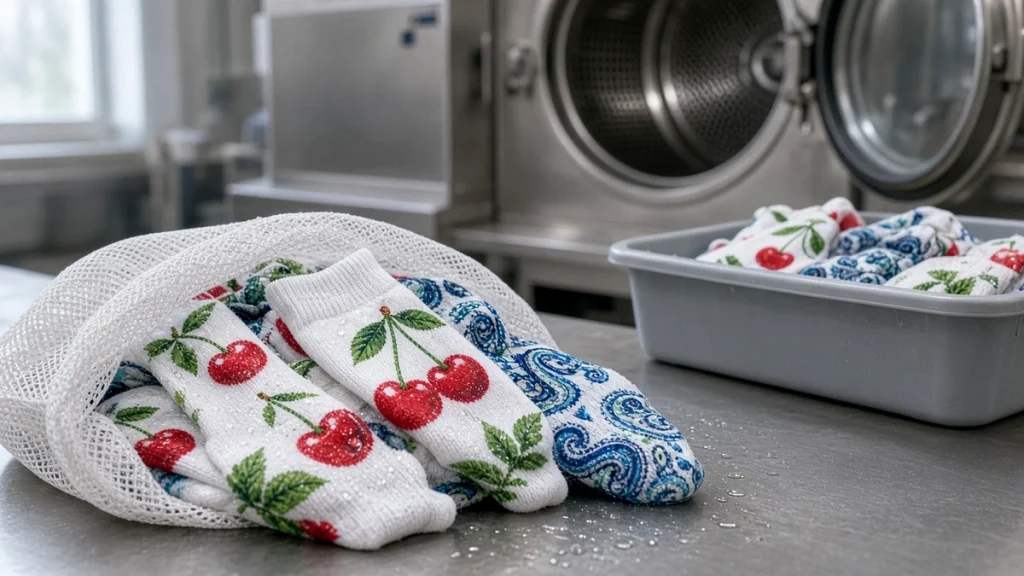
For cotton socks printed with reactive ink, the work is not finished after fixation. Washing removes unfixed dye and chemicals, spin drying removes water, and tumble drying finishes the sock. These steps strongly affect the final look and feel of digital print socks, and they are often where capacity bottlenecks appear.
Why washing is necessary
After fixation, some dye remains unfixed, and pretreatment chemicals remain in the fabric. If not removed:
- Colors may bleed in the customer's first wash.
- White areas may look stained.
- The sock may feel stiff.
Washing basics
Follow your ink and chemical supplier's procedures. General principles:
- Rinse to remove loose dye before hotter washes.
- Wash thoroughly to remove unfixed dye.
- Rinse until water runs clear.
- Avoid overloading the machine; socks need room to move.
A horizontal washer such as the CO-XPG30, a 30 kg unit, is designed for this kind of scouring and washing.
Spin drying
Removing water efficiently reduces drying time and energy. A centrifugal spin dryer like the CO753-600, with a 40 kg capacity, removes most water before tumble drying. Load evenly to keep the spin balanced.
Tumble drying
Tumble drying restores softness and prepares socks for packing. A steam-heated tumble dryer such as the COHE-130, a 30 kg unit, suits production volumes. Avoid excessive heat that could affect elastic.
Capacity planning
Washing and drying cycles take time. If they cannot keep up with printing, socks pile up. Calculate pairs per cycle and cycles per hour, then compare with printer output. See planning a production line around your socks printer.
Water and drainage
Plan adequate water supply and drainage. Follow local regulations for wastewater.
Quality checks
- Check rinse water for residual color.
- Inspect whites for staining.
- Check hand feel after drying.
- Wash test samples periodically.
Polyester note
Polyester socks printed with disperse ink usually skip washing, which is one reason polyester is popular for fast turnaround. See digital printing socks: polyester vs cotton.
Loading and balancing
Correct loading is one of the most overlooked factors in finishing quality. Overloaded washers do not move socks freely, so unfixed dye can redeposit onto white areas. Underloaded machines waste water and energy. Follow the rated capacity and keep loads consistent from batch to batch.
Spin dryers need balanced loads to run smoothly and safely. Distribute socks evenly around the drum and avoid mixing very wet and partly dry items. An unbalanced spin can cause vibration and slow the whole process.
Batch tracking through finishing
Cotton socks spend more time in finishing than polyester socks, and several batches may be in the washer, spin dryer and tumble dryer at once. Use labeled mesh bags, tags or bins to keep each order identified through every step. This is especially important for personalized orders, where mixing up two batches means reprints.
Scheduling finishing around printing
A practical rhythm is to print cotton orders early in the shift, fix them, then run wash and dry cycles while the printer continues with polyester orders. This keeps all equipment busy and prevents cotton orders from piling up at the end of the day. Our guide to planning a production line shows how to match capacities.
Water and energy awareness
Washing and drying use water and energy, so efficient habits matter for cost and sustainability. Run full but not overloaded loads, follow recommended temperatures rather than higher ones, and maintain machines so they run efficiently. Track usage per batch for a few weeks to understand your baseline and spot improvements. See is digital sock printing more sustainable?
Checking results
After drying, check that whites are clean, colors match the approved sample and socks feel soft. Equipment details are on the sock washing machine, spin dryer and sock dryer pages.
Common problems
Color staining whites: often too little rinsing or overloaded washers; wash promptly after fixation.
Socks feel harsh: residue may remain, or drying may be too hot.
Shrinkage: check blank quality and drying temperature.
Packing after drying
Let socks cool fully before folding and packing, so they do not trap moisture or heat. Pair them carefully, check sizes and match designs, then pack promptly to keep them clean. See packaging and fulfillment.
Store packed orders in a clean, dry area away from sunlight until dispatch, and label each package clearly with the order number.
Frequently asked questions
Can household washing machines be used?
For tiny volumes perhaps, but production needs capacity and consistency that industrial machines provide.
Why do whites look stained after washing?
Unfixed dye redeposited during washing; review fixation and washing procedures and avoid overloading.
How dry should socks be before packing?
Completely dry to prevent odor or mildew.
Conclusion
Washing, spin drying and tumble drying turn fixed cotton prints into finished, wash-fast digital print socks. Size these steps to match printing capacity and follow consistent procedures. Explore our pretreatment and finishing equipment or contact us to plan your cotton line.
Leave A Comment