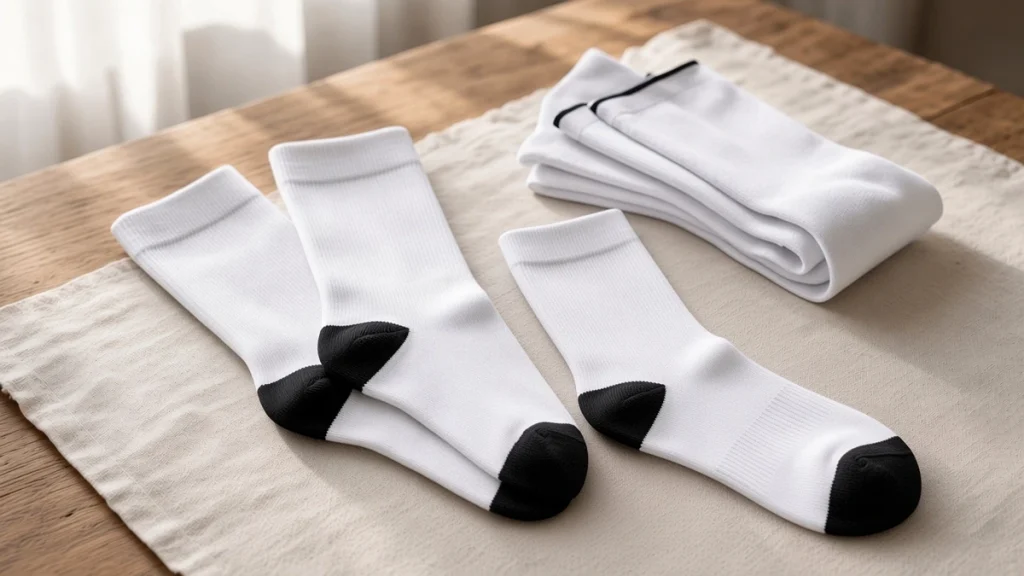
In digital printing socks, the blank is half the product. A perfect print file on the wrong blank produces pale colors, distorted designs or poor durability. Choosing the right blanks, and keeping them consistent, is one of the most important quality decisions a sock printer can make.
Fiber content
Match fiber to ink:
- Disperse ink (polyester route): choose blanks with high polyester content in the printed area. Lower polyester means paler prints because disperse dye only colors the polyester fibers.
- Reactive ink (cotton route): choose blanks with high cotton content. Synthetic fibers in the blend will not take reactive dye.
Elastane is usually present for stretch and fit; it is fine in small amounts but does not take most dyes.
Base color
Digital textile inks are transparent. White or very light blanks give the full color range. Colored blanks shift every color in the design and limit lighter tones.
Knit structure
- Fine, even knits give sharper detail.
- Consistent tension ensures even stretch on the roller.
- Smooth surface avoids texture that breaks up fine lines.
- Terry or cushioned areas can print differently from plain knit areas; test them.
Size and shape consistency
Blanks must fit your roller sizes predictably. Variation between batches causes stretch differences and distorted designs. Ask suppliers about tolerances and check incoming batches. See 360 sock printer rollers.
Surface finishing
Some blanks are treated with softeners, oils or finishes that block ink absorption or interfere with cotton pretreatment. Ask for print-ready blanks or test any new supplier.
Construction details
- Seamless toes improve comfort and avoid bulky seams under the print.
- Cuffs with rib structure may print differently; design accordingly.
- Heel shape affects how designs look when worn.
Ready-made print blanks
Using blanks designed for printing reduces variables. Options include blank polyester socks and blank cotton socks intended for digital printing workflows.
Testing new blanks
- Print a test chart and a typical design.
- Fix and finish exactly as in production.
- Check color, sharpness and white show-through when stretched.
- Wash test.
- Compare with your current standard.
Managing inventory
- Track blanks by supplier and batch.
- Keep enough stock of popular sizes.
- Store blanks in clean, dry, closed boxes to avoid dust and lint.
Working with blank suppliers
Treat your blank supplier as a production partner. Share your printing requirements clearly: fiber content targets, white base, surface finish and size tolerances. Ask to be notified before any change in yarn or finishing, because even small changes can affect print results. Request a pre-production sample of each new batch so you can test it before a large delivery.
Incoming inspection
A short inspection when blanks arrive prevents problems later:
- Check sizes against your roller chart.
- Check whiteness and surface cleanliness.
- Print and fix a test pair from each new batch.
- Record the batch number so you can trace any issue.
Building a blank specification
Write a one-page specification for each blank you use: fiber content, size measurements, color, construction details and approved supplier. Share it with buyers and suppliers. This document makes sourcing consistent and makes it easier to qualify an alternative supplier if needed. For printing results, compare our printed polyester socks and printed cotton socks.
Matching blanks to products
Different products need different blanks. Sports socks need cushioning and moisture handling, everyday socks need softness, and gift socks need a good look and feel out of the packaging. Choose a small set of blanks that cover your main products rather than many similar options; fewer blanks mean simpler roller charts, color profiles and stock control. Our blank polyester socks and blank cotton socks pages show options designed for printing.
Whiteness and surface
Digital printing builds color on the base fabric, so a bright, even white gives the most accurate colors. Check that blanks have no optical marks, yellowing or uneven areas, and that the knit surface is smooth and free of loose fibers.
Sizing consistency
Measure several pairs from each delivery. Inconsistent sizing causes fit problems on rollers and visible differences in print scale between pairs. Ask suppliers about their tolerances and how they control them.
Keep a few spare pairs of each approved blank as references for future comparisons.
Packaging of blanks
Ask suppliers to pack blanks flat and clean, in sealed bags, so they arrive without creases, dust or marks that could affect printing.
Frequently asked questions
Can I print black or navy socks?
Not with standard transparent inks if you want bright designs; use white blanks and print the dark background.
Do cotton blanks need special preparation?
Yes, pretreatment before printing with reactive ink. See printing cotton socks.
Does fiber content affect durability?
Yes. Matching fiber to ink and fixing correctly are key. See digital print socks durability.
Conclusion
Choose blanks for digital printing socks by fiber content, white base, even knit, size consistency and clean finishing, then test before switching suppliers. Explore print-ready blank socks or contact us for sourcing advice.
Leave A Comment