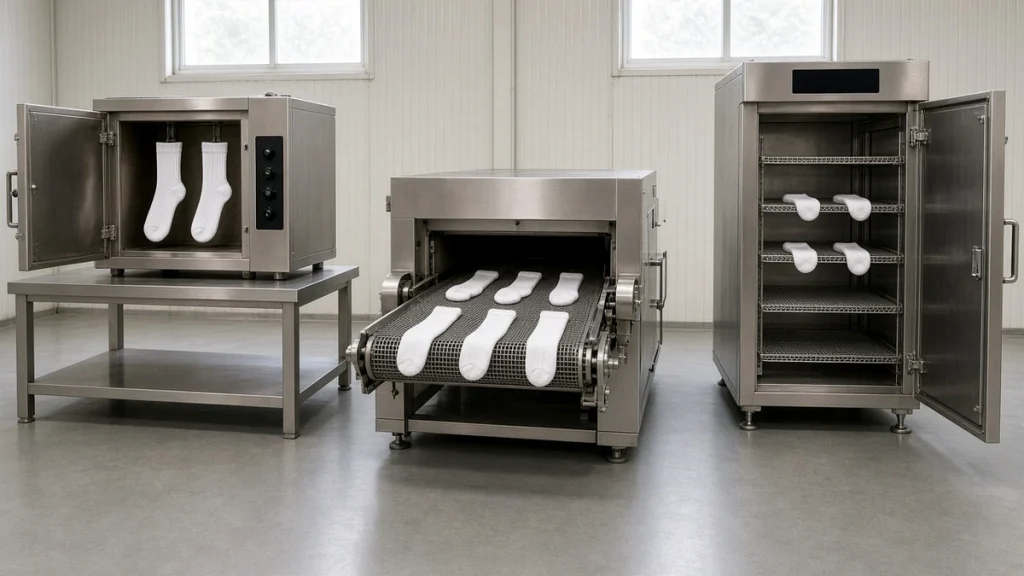
Choosing a sock oven is one of the most important decisions after choosing the printer. The right oven keeps up with production, fixes prints consistently and fits your space and power supply. This guide compares the main types and offers a simple decision path.
Start with your fiber
Polyester with disperse ink needs high-temperature heat fixation. Benchtop and chain ovens designed for polyester are the standard tools.
Cotton with reactive ink needs steam or low-temperature fixation followed by washing. A steamer or a low-temperature oven is used instead of a high-temperature polyester oven.
If you print both, you will likely need both types.
Option 1: Benchtop polyester oven
Example: COHE-150, a 1.5 kW benchtop oven.
Best for: small studios, sampling, desktop and single-roller printers.
Pros: compact, modest power requirement, low investment.
Cons: batch processing limits throughput; more handling per pair.
Option 2: Conveyor-chain polyester oven
Example: COHE-1801, a 15 kW conveyor-chain oven.
Best for: continuous production with twin-roller or four-roller printers.
Pros: continuous flow, consistent dwell time, less handling.
Cons: larger footprint and higher power requirement.
Option 3: Extended-chain polyester oven
Example: COHE-1802, a 30 kW extended-chain oven.
Best for: high-volume lines or multiple printers.
Pros: highest capacity, supports growth.
Cons: requires substantial power and space.
Option 4: Low-temperature cotton oven
Example: COHE-1803, a 30 kW low-temperature cotton oven.
Best for: reactive ink fixation on cotton where steam supply is not convenient.
Pros: no steam boiler needed.
Cons: still requires washing and drying afterwards.
Option 5: Steamer for cotton
Example: COST-1802.
Best for: traditional steam fixation of reactive prints.
Pros: proven method for reactive dyes.
Cons: needs a steam supply.
Compare cotton options in steaming vs oven fixation.
Decision path
- Which fibers do you print? Polyester, cotton or both.
- What is your realistic daily output?
- What power supply is available? Check voltage, phase and capacity.
- How much floor space do you have?
- Do you plan to add printers within two years?
If output is small and space limited, start with a benchtop oven. If output is steady and growing, a chain oven pays back in reduced handling and consistent results.
Matching to your printer
- Desktop or single-roller printer: benchtop oven often sufficient.
- Twin-roller printer: benchtop for low volume, chain oven for steady production.
- Four-roller printer: chain oven recommended.
See four-roller vs twin-roller socks printer.
Installation considerations
- Electrical supply and dedicated circuits.
- Ventilation for heat.
- Clearance for loading and maintenance.
- Proximity to the printer to minimize handling.
Questions to ask before buying an oven
- How many pairs per hour does it handle, and does that match your printer output?
- Which fibers and inks is it suitable for?
- How even is heat across the working area?
- What power supply and ventilation does it need?
- How much floor space does it occupy, including loading?
Testing fixation results
Whatever oven you choose, test it with your inks and blanks. Fix sample pairs at the recommended settings, then check color strength and wash results. Adjust time and temperature in small steps and record the best settings for each product.
Matching oven to growth
If you plan to add a second printer, consider an oven that can handle the combined output. See scaling up with a second socks printer and our sock oven guide.
Matching oven type to workflow
Think about how socks move through your shop. A continuous chain-style oven suits steady flow, where operators feed printed socks in and collect them at the other end. A batch or benchtop unit suits smaller volumes and flexible scheduling. For delicate blends, lower-temperature settings and longer times may be needed; always follow ink and blank guidance. Browse the sock heating oven, socks oven and cotton socks oven pages, and see all pretreatment and finishing equipment.
Operating tips
- Warm up fully before the first batch.
- Keep loads consistent in size and spacing.
- Clean the oven regularly to remove lint.
- Check settings when changing blanks or inks.
Questions to ask suppliers
Does the oven match my printer? Ask how many printers of your type the oven usually supports.
What maintenance does it need? Ask about cleaning, belt or rack care and which parts wear.
Can I see it with my socks? Request a test with your blanks so you can wash-test the result before buying.
Choosing the oven together with the socks printer, rather than as an afterthought, keeps your line balanced from the start.
Frequently asked questions
Can I upgrade later?
Yes. Many businesses start with a benchtop oven and add a chain oven as volume grows, keeping the benchtop for samples.
Do ovens need maintenance?
Keep chambers clean of lint, check chains and fans, and verify temperatures periodically.
What about drying after washing?
That is a separate step using a tumble dryer such as the COHE-130.
Conclusion
Choose a sock oven by fiber first, then volume, power and space. Benchtop ovens suit small studios, chain ovens suit continuous production, and cotton needs steam or low-temperature fixation. Read more in our sock oven guide, compare the finishing range, or contact us for advice.
Leave A Comment