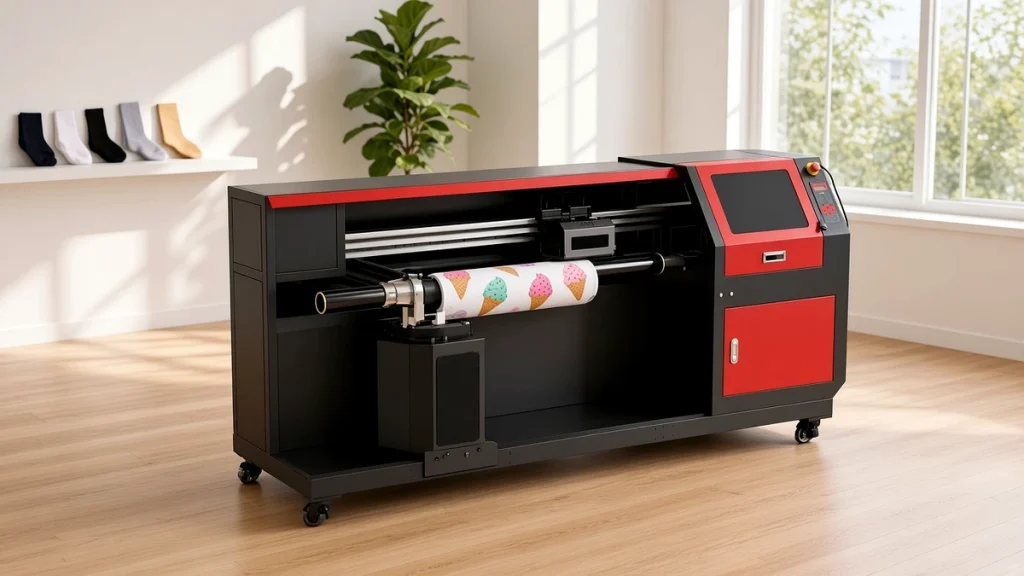
Search for a "socks printing machine" and you will find very different equipment under the same name: small heat presses with sock jigs, screen printing carousels and industrial rotary digital printers. Each can decorate socks, but they produce very different results at very different scales. This guide explains the main types so you can compare like with like.
Type 1: Heat press with sock jigs
How it works: a flattened polyester sock is placed on a jig, sublimation transfer paper is applied, and a heat press transfers the design.
Strengths: low start-up cost, easy to learn, compact.
Limitations: pale side lines where the sock folds, polyester only, labor-intensive for volume, paper waste.
Best for: hobbyists, very small sellers, market testing.
Type 2: Screen printing
How it works: ink is pushed through a stencil screen onto a flattened sock, one screen per color.
Strengths: fast per piece for large runs of simple designs, opaque inks available.
Limitations: setup for every design and color, limited coverage, not suited to photos or personalization.
Best for: large runs of simple logos.
Type 3: Rotary digital socks printing machine
How it works: the sock is pulled over a roller; inkjet heads print the design as the roller rotates, producing seamless 360° coverage.
Strengths: no side lines, full color and photo quality, no setup per design, one-pair orders, supports polyester and, with the right ink and finishing, cotton and other fibers.
Limitations: higher equipment cost, requires fixation and finishing equipment, needs routine printhead maintenance.
Best for: custom sock brands, print on demand, factories adding printed lines, promotional companies.
When most professionals say "socks printing machine" today, they mean this type. Our socks printer beginner's guide explains how it works.
Configurations of rotary machines
Rotary digital machines come in several layouts:
- Desktop for compact studios and sampling, such as the CO80-600DK.
- Single-roller for entry-level production, such as the CO70-220PRO.
- Twin-roller for flexible production and longer tubes, such as the CO60-100PRO.
- Four-roller for continuous high output, such as the CO80-210PRO.
What drives cost
When comparing quotes for a socks printing machine, cost depends on:
- Number of rollers and printheads. More stations and heads raise output and price.
- Print length and roller range. Longer products need larger machines.
- Software. RIP licenses and color management tools.
- Finishing equipment. Ovens, steamers, washers and dryers.
- Support and training. Included services vary widely.
Do not compare machine prices alone; compare the cost of a complete line that delivers finished socks. Our socks printer ROI guide shows how.
Running costs
- Ink, which depends on coverage.
- Blanks.
- Energy for printing, fixation and drying.
- Labor.
- Spare parts such as dampers, caps and printheads.
- Pretreatment chemicals for cotton.
Choosing the right type
Ask yourself:
- Do customers expect seamless all-over designs? If yes, rotary digital.
- Do you need cotton? If yes, rotary digital with reactive ink.
- Are orders small and varied? If yes, rotary digital.
- Are orders huge and simple? Screen printing may compete.
- Is your budget very limited and volume tiny? A heat press can be a starting point.
Matching machine type to business type
Different businesses need different things from a socks printing machine:
- Start-ups and studios usually value a compact footprint, simple operation and low minimums.
- Print-on-demand sellers need reliable daily output and an efficient file workflow.
- Sock factories often want higher throughput and integration with existing finishing.
- Promotional product suppliers value fast sampling and the ability to print many small orders.
Costs beyond the machine
When comparing costs, include fixation and finishing equipment, inks, blanks, spare parts, training, installation, electricity and space. Ask suppliers for typical consumable usage and replacement parts so you can estimate running costs with your own volumes. Our budgeting guide lists the items to include, and socks printer ROI shows how to estimate payback.
Getting proof
Ask each supplier to print your designs on your blanks. Compare color, sharpness, seam alignment and hand feel after washing. Request references from users with similar businesses.
Next steps
Read our sock printing machine FAQ, 8 features that matter in a sock printing machine and browse the socks printer range. For finishing, see choosing a sock oven.
Frequently asked questions
Is a socks printing machine the same as a socks printer?
In professional use, yes; both usually refer to rotary digital machines. Some sellers also use the term for heat presses, so check what is actually offered.
Can one machine print different sock sizes?
Yes, rotary machines use interchangeable rollers sized for different socks.
What else can it print?
Sleeves, beanies, gaiters, sweatbands and more. See what else a socks printer can print.
Conclusion
A socks printing machine can mean a heat press, a screen carousel or a rotary digital printer. For seamless, full-color and short-run socks, rotary digital is the professional standard. Compare models in our socks printer range or contact us to discuss your needs.
Leave A Comment