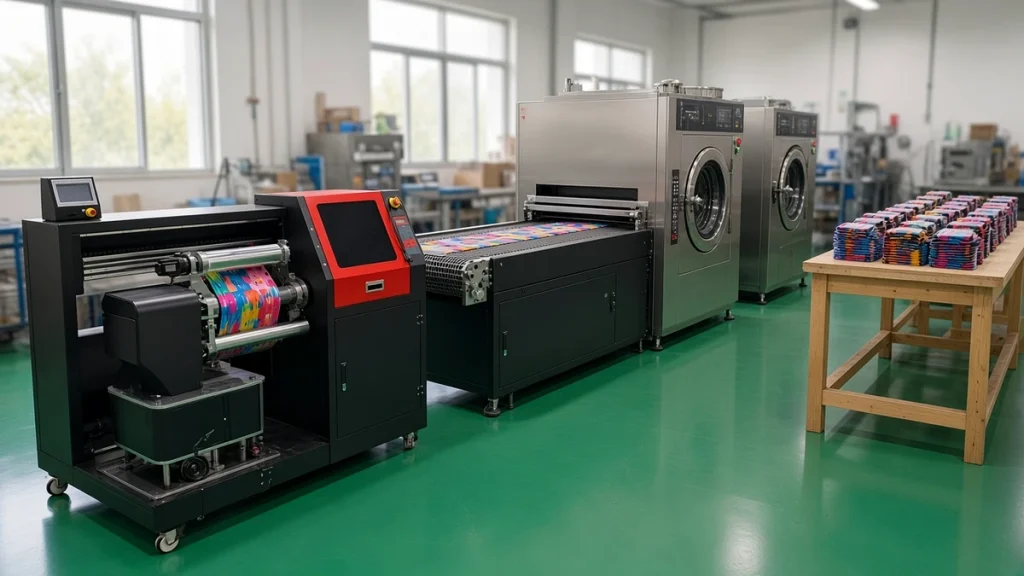
A common story in new print rooms goes like this: the socks printer arrives, it prints beautifully, and within a week there are piles of printed socks waiting for the oven, or wet cotton socks waiting for the dryer. The printer was never the bottleneck. Planning a production line around your socks printer means sizing every step to the same daily target and arranging them so work flows without backtracking.
Step 1: Define your daily target
Start with a number: pairs per shift you need to finish, not just print. Base it on realistic sales, not maximum machine output. Every other decision follows from this number.
Step 2: Map the route for each fiber
Polyester route: load → print → heat-fix → inspect → pack.
Cotton route: pretreat → dry → load → print → steam or low-temperature fix → wash → spin dry → tumble dry → inspect → pack.
If you print both, decide whether they share space or run in separate zones. Cotton steps involve water and steam, so keeping them apart from the printer area helps control humidity and lint.
Step 3: Size each step
For each step, estimate capacity per hour:
- Printer: based on reference output for your typical design and sock length.
- Oven: based on chain speed and dwell time, or batch size and cycle time for benchtop units.
- Steamer: batch size and cycle time.
- Washer and dryers: kilograms per load and cycle time, converted to pairs.
Then compare. The step with the lowest capacity sets your line speed. Upgrading the printer when the oven is the bottleneck achieves nothing.
The pretreatment and finishing range is designed so that capacities can be matched, from a 1.5 kW benchtop oven to 30 kW production ovens and 30–40 kg washers and dryers.
Step 4: Arrange the flow
Lay out equipment in the order of the process, ideally in a straight line or U-shape:
- Blank storage near the printer.
- Printer with a clean loading table.
- Oven or steamer close to the printer exit.
- For cotton: washer, spin dryer and tumble dryer grouped together with water and drainage.
- Inspection table with good daylight-balanced lighting.
- Packing and shipping area.
Avoid layouts where operators carry socks back and forth across the room.
Step 5: Plan utilities
- Electricity: ovens and dryers draw significant power; check your supply and phase.
- Steam: steamers and some dryers need a steam supply at specified pressure.
- Water and drainage: essential for washing.
- Ventilation: ovens and dryers release heat; plan airflow.
- Climate control: keep the printer zone stable in temperature and humidity.
Our article on socks printer workspace requirements lists what to measure.
Step 6: Plan staffing
A typical small line might have one person loading and printing, one handling fixation and finishing, and one inspecting and packing. As volume grows, multi-roller printers like the CO80-210PRO benefit from a dedicated loader. Cross-train staff so the line keeps running during breaks and absences.
Step 7: Build in buffers
Small buffers between steps, such as a rack holding an hour of printed socks before the oven, smooth out variations. Large buffers hide problems; if a pile keeps growing, that step needs more capacity.
Matching ovens to printers
A continuous chain oven such as the COHE-1801 suits steady polyester production, while the extended COHE-1802 offers more capacity. For cotton, pair the printer with the COST-1802 steamer or COHE-1803 low-temperature oven. The sock oven guide explains the differences.
Step 8: Measure and improve
Once running, track pairs completed per step per hour. Within a few weeks you will see where the real bottleneck is. Improve that step, then measure again.
A simple capacity check
Before buying equipment, check capacity stage by stage. For each step, estimate how many pairs per hour it can handle and how many hours it runs per shift:
- Socks printer output
- Fixation: oven or steamer throughput
- Cotton only: washing, spin drying and tumble drying
- Quality check and packing
The slowest stage sets the output of the whole line. If the oven handles fewer pairs than the printer produces, printed socks pile up. If packing is slow, finished socks wait and orders ship late.
Layout principles
- Keep flow in one direction: blanks in, printed socks moving forward, finished goods out, without crossing paths.
- Separate wet and dry areas: pretreatment and washing away from the printer and electronics.
- Leave space for buffers: small staging tables between stages smooth out uneven flow.
- Plan for maintenance access around every machine.
Growing the line
Plan where a second socks printer or extra fixation equipment would go before you need it. Electrical capacity and ventilation are much easier to add during initial setup. See workspace requirements, choosing a sock oven and the production process page.
Conclusion
A socks printer delivers its full value only when fixation, washing, drying and packing keep pace. Define a target, map the route, size every step, arrange a logical flow and plan utilities and staff. To see a complete line, visit our production process page and factory tour, or contact us for a layout recommendation.
Leave A Comment