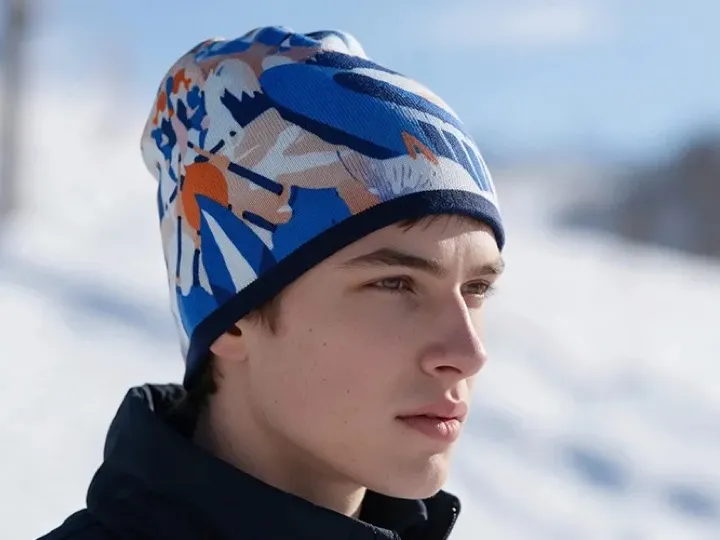
Socks are just the beginning of tubular textiles. Beanies, sports headbands, neck gaiters, and boxer briefs share a similar construction: knitted tubes made from stretchy fabrics. That makes them natural candidates for 360° rotary printing.
But stretch fabrics bring their own challenges. Fiber blends, elasticity, and thickness all affect how a design prints and how it looks when worn. This guide explains what to consider when printing these products.
Why Stretch Matters
Stretch fabrics are designed to expand. A design printed on a roller is stretched to a certain width, and then the product relaxes after printing. When worn, it stretches again, sometimes more and sometimes less than on the roller. That cycle affects:
- Image size and proportion. Designs may look wider or narrower when worn.
- Color density. Heavily stretched areas can look lighter if the knit opens up.
- Text readability. Small text can distort.
Planning for stretch is the key to good results.
Common Fibers in Stretch Tubular Products
Polyester and spandex
Common in sports headbands, neck gaiters, and some activewear. Polyester-rich fabrics are generally printed with disperse inks and heat-set.
Nylon and spandex
Common in seamless underwear, boxer briefs, and some performance headwear. Nylon is commonly printed with acid inks, usually with pretreatment and finishing steps.
Cotton blends
Found in casual beanies and some underwear. Cotton typically uses reactive inks with pretreatment and finishing.
Acrylic and wool knits
Many traditional beanies use these. Printability varies, so test carefully and consult your ink and blank suppliers.
The rule of thumb: identify the main printable fiber on the surface, choose the matching ink system, and test before production.
Product-by-Product Tips
Beanies
- Thick knits and ribbed textures can make fine detail harder to reproduce. Bold designs often work best.
- Folded cuffs hide part of the design. Plan placement so the logo shows when the cuff is folded.
- Test how the design looks across the rib pattern.
Sports headbands
- Headbands are narrow, so keep designs simple and centered.
- Logos and stripes read well. Very detailed images may get lost.
- Moisture-wicking polyester blends are common.
Tubular headwear and neck gaiters
- These are worn in many ways (neck, face, head), so all-over patterns usually work better than a single logo.
- Colorido’s CO70-220PRO has an open single-arm structure that also suits tubular headwear and makes changeovers easier.
Boxer briefs
- Waistbands are usually separate or a different construction. Check what part of the garment you can print.
- Comfort is critical, so choose soft, stretchy blanks and test hand feel after printing.
- All-over prints are popular, but test how they look on the body.
Roller Size and Loading
Each product needs a roller of a suitable size:
- Too small: the product sits loosely, which can cause misalignment.
- Too large: the product overstretches, which can distort the design and the fabric.
Load products evenly, with no twists, and keep the stretch consistent from piece to piece. Train operators to load the same way every time.
For larger garments like seamless yoga wear, a machine with large-diameter rollers, such as the CO220-450MAX yoga-wear printer, is designed for the job.
Artwork Tips for Stretch Fabrics
- Design at worn size. Consider how much the product stretches on the body.
- Use bold shapes. They hold up better than fine lines.
- Avoid tiny text. If text is necessary, keep it large and simple.
- Test gradients. Some stretch fabrics show gradients beautifully, while others look grainy when stretched.
- Proof on real products. Screen mockups can’t show stretch effects.
Finishing and Care
Follow the finishing process that matches the ink: heat setting for disperse inks, or fixing and washing for reactive and acid inks. Then test:
- Wash durability
- Color after stretching
- Hand feel and comfort
Give customers clear care instructions, such as washing inside out and avoiding high heat, to help prints last.
Building a Product Family
Stretch accessories pair well with socks. Popular combinations include:
- Team socks plus matching headbands and sweatbands
- Winter socks plus printed beanies
- Underwear brands pairing boxer briefs with matching custom printed socks
See our custom printed socks as a base for building coordinated collections.
FAQ
Can I print beanies with a sock printer?
It depends on the beanie size, fabric, and the machine’s roller options. Test with your supplier.
Which ink is used for nylon headwear?
Nylon is commonly printed with acid inks, followed by appropriate finishing.
Why does my design look lighter when the product is stretched?
When the knit opens up, more of the base yarn shows. Test stretch levels and adjust artwork or settings.
Is printing boxer briefs difficult?
It’s very doable with the right blanks and roller size, but careful testing for comfort and durability is essential.
Leave A Comment