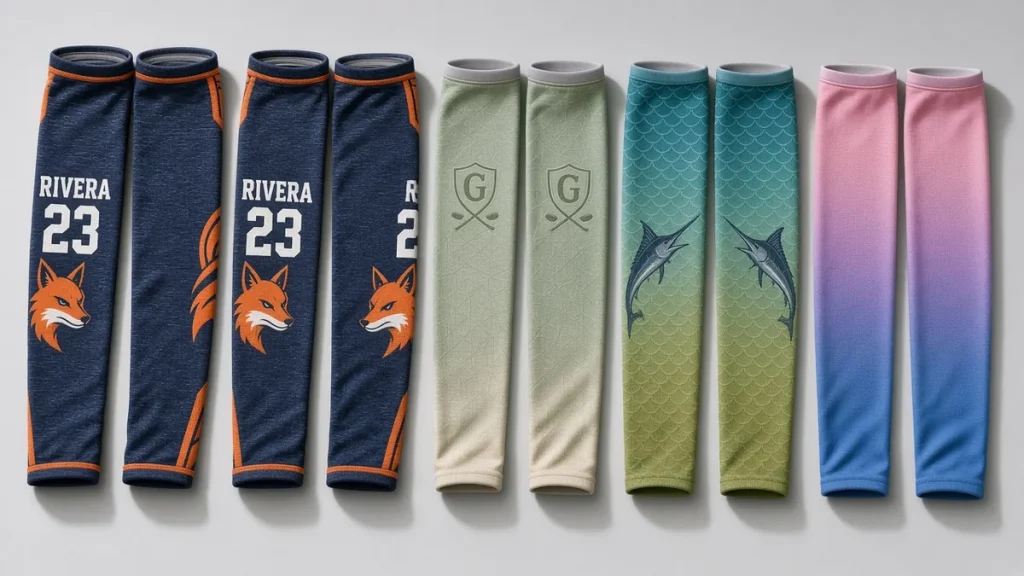
Custom cooling arm sleeves are an easy summer product to sell to teams, golf days, cycling clubs and outdoor brands. They are light, easy to ship and worn for hours in full view. The hard part is the order itself: minimums vary widely, “ice silk” can mean different fabrics, and the print method decides whether a logo cracks, a gradient wraps around the arm or a white line runs down the side. This guide is for team-wear suppliers, promotional distributors and print shops planning custom arm sleeves for the 2027 season.
Timing matters. Summer is starting in Australia, New Zealand and South America, and northern-hemisphere buyers are planning spring and summer programmes now.
What Are Custom Cooling Arm Sleeves?
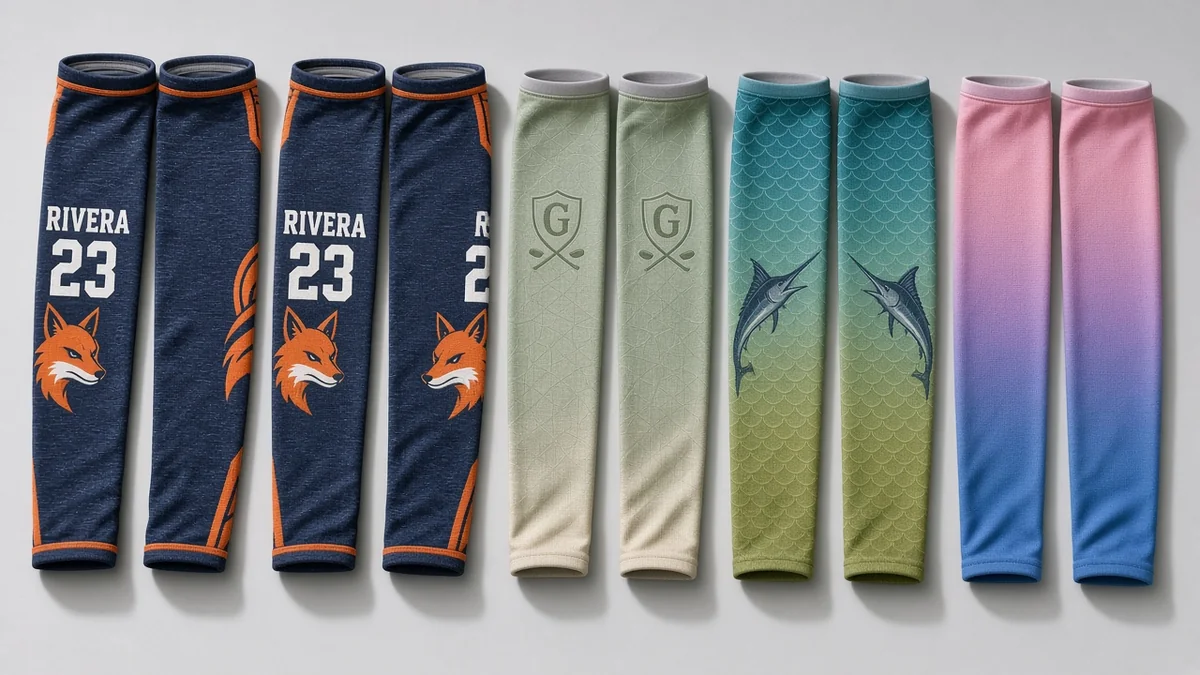
A cooling arm sleeve (also called an ice sleeve, sun sleeve or UV arm sleeve) is a stretch knit tube worn from wrist to upper arm, usually polyester or nylon with spandex, often with a silicone gripper at the top. Compression sleeves for basketball, baseball and football are knitted tighter for a snug fit.
“Custom” can mean three things, and it helps to agree which one before you quote:
- Logo on a stock sleeve: one mark in one position, usually embroidered, screen printed or heat transferred.
- Full custom artwork: team colours, patterns or a photo printed over the whole sleeve.
- Personalized sleeves: a shared design with a different name, number or photo on every pair.
“Cooling” depends on the fabric, not the print. When Hong Kong’s Consumer Council tested 20 UV protection arm sleeves, 19 measured above UPF 50, yet two models with no cooling claim performed remarkably well on cooling and comfort, while two that claimed cooling scored 2.5 points or less out of 5. Choose the blank for how it handles sweat and air, then a print method that keeps it breathable.
5 Ways to Decorate Custom Arm Sleeves
Each method suits a different order size and level of design freedom. Here is how they compare on a stretch tube:
| Method | How it works | Design freedom | Setup per design | Best for |
|---|---|---|---|---|
| Embroidery | Logo stitched onto a finished sleeve | Small logo, limited colours | Digitised stitch file | Premium logo on plain sleeves |
| Screen print / silicone transfer | Ink or silicone layer applied on the surface | Spot-colour logos | Screens or transfer plates | Large runs of one logo |
| Jacquard knit-in | Pattern knitted from coloured yarns | Flat shapes, limited yarn colours | Knitting programme and sampling | Very large, repeat programmes |
| Flat heat-press sublimation | Transfer paper pressed onto a flattened sleeve, one side at a time | Full colour, but risk of edge lines | Printed transfer paper | Polyester sleeves, small to medium runs |
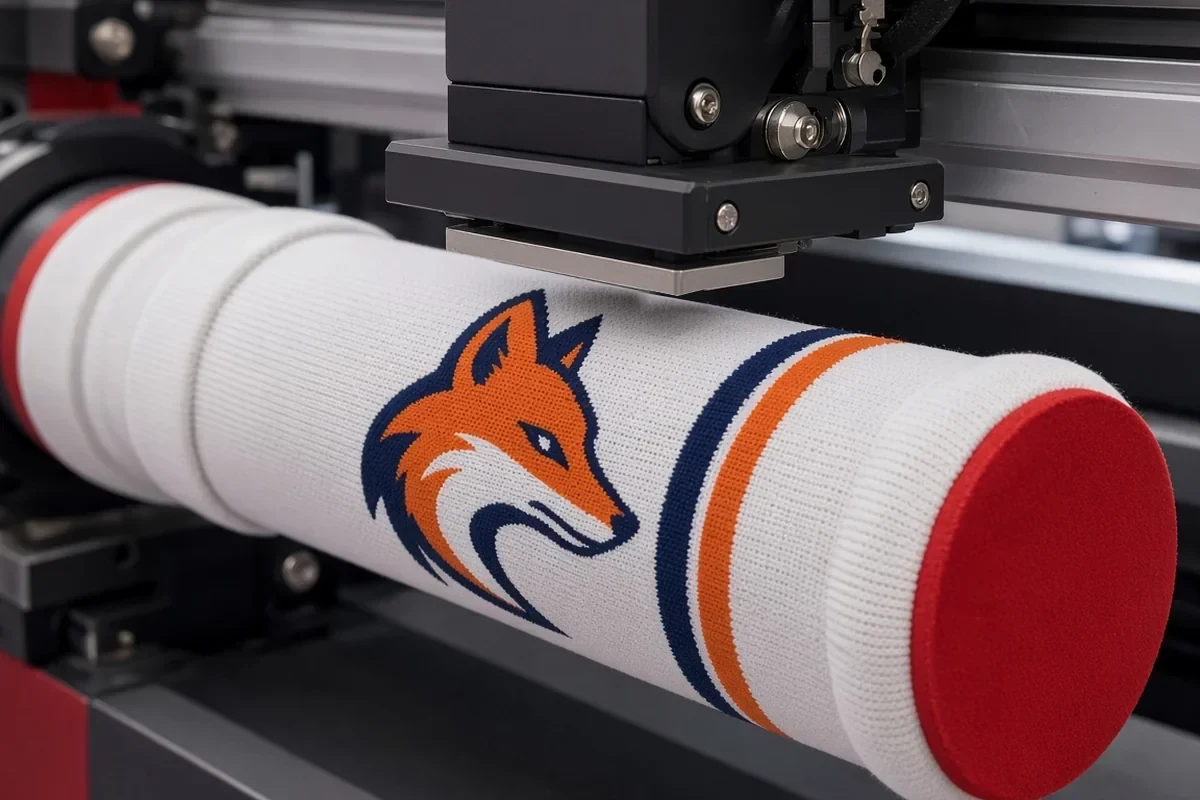
| 360° seamless digital printing | Ink jetted onto the tube as it turns on a roller in a sock printer | Full colour, all-over, changes every pair | Digital file only | Team names, gradients, photos, short runs |
Minimums follow the setup. Published examples we checked in November 2026 range from 50 pairs for sublimated seamless sun sleeves to 500 pairs for logo branding and 1,000 pairs embroidered or 3,000 pairs screen printed at other suppliers. When an order needs a different name on every pair, only methods driven by a digital file stay practical.
Why flat sublimation can leave a line down the arm
With a heat press, the sleeve is flattened and pressed one half at a time; Graphics Pro describes cutting the transfer in half and pressing each side separately. SanMar recommends a jig and about 1/8 inch of overlap on tubes, and warns that too much overlap can print a dark line on light colours. A rotary roller never flattens the tube, so there is no fold; the artwork still needs repeat-ready edges.
Fabric First: Polyester, Nylon and the Ink Route
Choose the ink by the fibre, not by the sleeve’s marketing name, and check the composition label before quoting.
- Polyester and spandex: the usual choice for full-colour sleeves. The route is disperse (sublimation) ink, then heat fixation in an oven such as the Sock Heating Oven COHE-1801 or the Socks Oven COHE-1802. The COHE-1801 page states it is designed for polyester tubular products.
- Nylon and spandex: often sold as “ice silk”. Nylon generally needs acid ink with its own pretreatment and finishing steps, so confirm the process with a sample before you promise colours.
- Colour of the blank: standard CMYK printing needs a white or light blank, because it cannot lay an opaque white over a dark sleeve.
For a deeper look at the two decoration routes, see sublimation vs 360° digital printing for tubular textiles.
UPF and Cooling Claims: Keep Them Honest
Sun protection is why many people buy UV arm sleeves, so claims matter. Australia’s radiation safety agency, ARPANSA, classifies UPF 50 and 50+ as “excellent” protection. It also notes that stretching a knitted fabric normally lowers its UPF, and that colour, thickness and construction all change the result.
- Get a UPF report on the blank, and re-test the printed sleeve before putting a rating on packaging.
- Treat colourways separately; darker colours generally absorb more UV.
- Base “cooling feel” claims on fabric data, not on the print.
Design Ideas That Sell by Sport
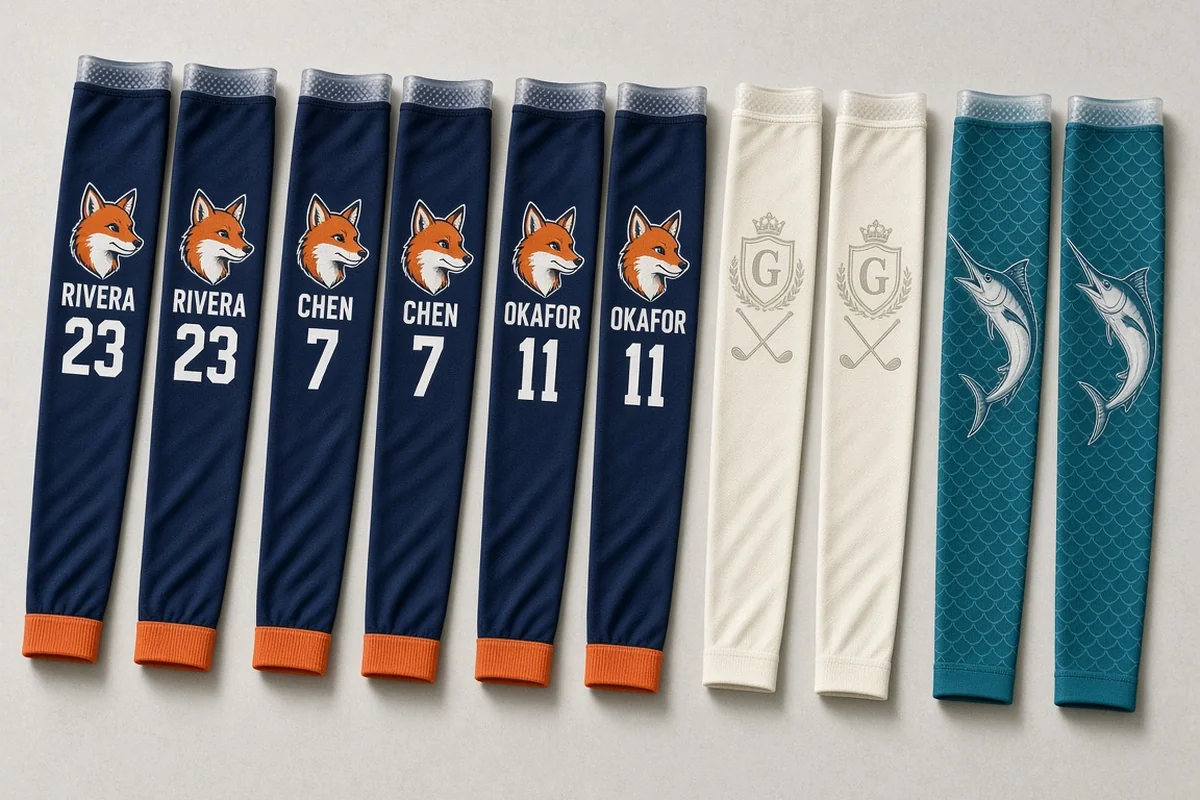
- Basketball, baseball, softball and football: team colours, the mascot, and each player’s name and number on the outer forearm.
- Golf: club crests, tournament dates and sponsor marks for corporate golf days, often bundled with a cap or towel.
- Fishing: fish-scale textures, camouflage and species artwork running wrist to bicep.
- Cycling and running: club kit patterns and event names. Match the sleeves to custom team socks for a complete kit.
- Outdoor work and events: high-visibility colours and a company logo.
For ready artwork, see the 11 designs in our custom printed ice sleeves collection, such as the tiger red black ice sleeve.
Artwork rules for a tapered tube
- Put the focal point on the outer forearm. That is the side people see.
- Keep text away from the gripper and the wrist cuff. The fabric gathers at the ends.
- Make the edges repeat-ready. The left and right edges of the file must match for the print to look seamless around the arm.
- Allow for stretch. The sleeve stretches more over the bicep than at the wrist, so check logos on a worn sample.
- Decide on left and right. Choose identical or mirrored sleeves before printing, then pack them as pairs.
Our artwork file prep guide explains templates for 360° printing.
Plan the 2027 Arm Sleeve Season Now
Work backwards from the date the sleeves must be in customers’ hands:
- Now: pick blanks, confirm the fibre and request UPF documentation.
- Artwork: one template per sleeve size, approved on a digital mock-up.
- Sample: print, fix, wash and wear-test; check colour, stretch and seam.
- Bulk: lock quantities, the name-and-number roster and pair packing.
Southern-hemisphere orders are due now; northern spring sports and golf programmes should finish sampling early in the new year.
Printing Custom Arm Sleeves In-House
If you already print socks, the same rotary platform can print arm sleeves. Colorido’s product pages list sleeves for these Socks Printer models:
- Socks Printer CO80-600DK: desktop, 2 × Epson I1600 heads, 82 mm roller, 20–30 pairs/hour reference output; lists ice sleeves and wrist guards. Suits sampling and personalized orders.
- Socks Printer CO70-220PRO: single roller, open arm; swap cylinder sizes to print socks, neck gaiters, ice sleeves and wristbands. 20–30 pairs/hour.
- Socks Printer CO60-100PRO: twin roller, 2 or 4 Epson I1600 heads, 60–100 mm rollers, 40–65 pairs/hour; lists sleeve covers (ice sleeves) and wrist bands.
- Socks Printer CO80-210PRO: four rollers, 2 × Epson I1600 heads, 50–120 pairs/hour for continuous production; also prints sleeve covers and wristbands.
Output figures are factory references for socks; sleeve output depends on length, coverage and print mode. Compare models on the Socks Printer page, and for the operator side read printing ice sleeves on a rotary socks printer and arm sleeves and sweatbands as a new revenue stream.
Get a Sample of Your Custom Arm Sleeves
Send us your blank sleeve’s fibre composition and finished size, your artwork and your expected quantity. We will recommend the Socks Printer, roller and finishing set-up, or quote finished printed sleeves. Contact the Colorido team, or watch rotary printing live and ask questions on our weekly YouTube live stream.
FAQ
Can a sock printer print arm sleeves?
Yes, if the model and roller suit the sleeve. Colorido lists arm sleeves or ice sleeves for the CO80-600DK, CO70-220PRO, CO60-100PRO and CO80-210PRO Socks Printers.
What is the best printing method for custom compression arm sleeves?
For full-colour designs on stretch fabric, use a dye-based method such as sublimation or 360° digital printing with disperse ink on polyester. Thick surface layers can crack when the sleeve stretches.
Does printing change the UPF of an arm sleeve?
UPF depends mainly on the fabric’s knit, thickness, colour and stretch. If you want to print a UPF rating on packaging, test the finished, printed sleeve.
Can every pair have a different name and number?
Yes. With 360° digital printing each pair is printed from its own file, so a team roster can be produced in one run without screens or a knitting set-up.
Can you print full-colour designs on black arm sleeves?
Standard CMYK needs a white or light blank. For a dark look, print the dark colour as part of the design.
Leave A Comment