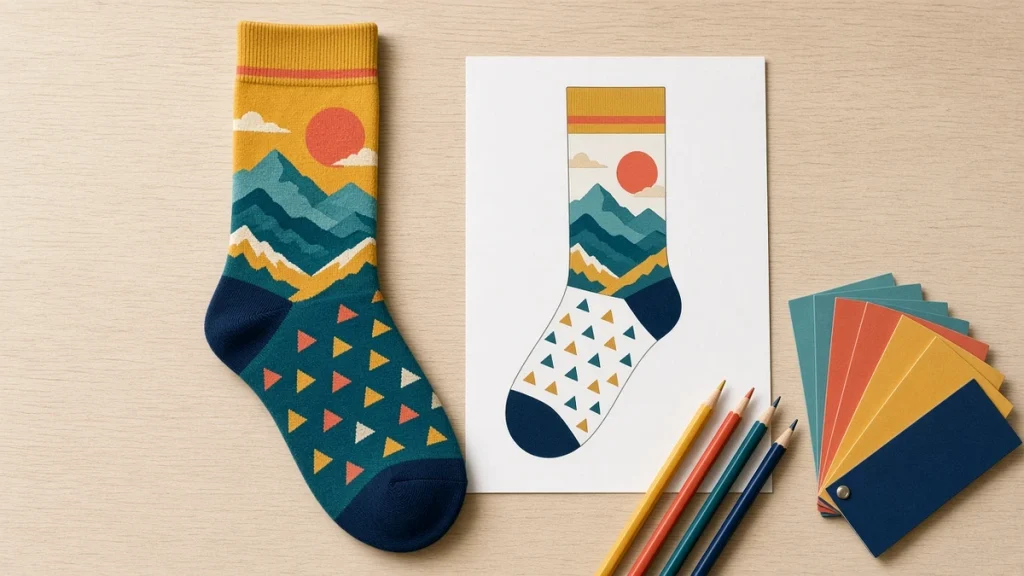
A great sock design is not just a great illustration placed on a sock. It works with the shape of the foot, the stretch of the fabric and the way people see socks: at the ankle, in a photo, in a gift box. These practical tips help designers create custom printed socks that look great and sell well.
Think in zones
Socks have distinct visible zones:
- Cuff: seen above the shoe; ideal for names, logos and focal elements.
- Leg: the main storytelling area, visible with shorts or cropped trousers.
- Heel: stretches when worn; avoid faces and text.
- Foot: hidden in shoes; use patterns or playful details.
- Toe: a fun place for surprises.
Placing the main subject on the leg, just below the cuff, gives the best visibility.
Design for the wrap
On a 360° printed sock, the design wraps around. Make sure:
- The left and right edges join seamlessly.
- The main subject appears on the outer side of each sock, or mirrored for pairs.
- Patterns repeat cleanly around the circumference.
Our artwork preparation guide explains templates and joins.
Choose colors wisely
- High-contrast designs read well from a distance.
- Very bright screen colors may print slightly duller on fabric.
- Large solid areas show any unevenness; textures and patterns are more forgiving.
- Consider how colors look on both polyester and cotton if you offer both.
Read socks printer color management for technical background.
Faces and pets
Faces are popular but tricky:
- Use high-resolution, well-lit photos.
- Crop tightly so the face is large enough to recognize.
- Place faces on the leg, not the heel.
- Test stretch: faces can widen slightly when worn.
Patterns
All-over patterns are forgiving and versatile. Use tiles that repeat seamlessly and match the template width to a whole number of repeats. Small-scale patterns hide stretch distortion well.
Text
- Keep text short and large enough to read on the foot.
- Use bold fonts; thin strokes can disappear.
- Place text at the cuff or along the leg.
Collections, not single designs
Customers like choice. Design collections around a theme: a holiday collection, a dog breed series, a food set. Collections encourage multi-pair purchases and make marketing easier. Browse themes like custom food socks, custom art socks and custom Easter socks.
Packaging and presentation
Design does not end at the sock. A matching band, card or box turns custom printed socks into a gift. Photograph pairs on feet and flat-lay for listings.
Test before you launch
- Print samples on your production blanks.
- Wear them: check how designs look on the foot.
- Wash test.
- Photograph and share with a small audience.
- Launch winners; refine or drop the rest.
Digital printing makes this iteration cheap and fast.
Testing designs before a full launch
Even experienced designers cannot always predict what will sell. A low-risk approach is to print a few pairs of each new design, photograph them and test reactions with your audience through social posts, email or a small pre-order. Keep the winners and drop or rework the rest. Digital printing makes this possible because there are no screens or knitting setups to pay for.
Building a collection
Customers often buy more than one pair when designs feel connected. Build collections around a theme, a color story or an occasion, and offer bundles. A consistent style also makes your brand easier to recognize.
Writing product listings
Describe the design, fiber, sizes and care clearly. Use names that help search, such as "custom printed socks with dog portrait" rather than only creative titles. Our guide to selling on Etsy and Shopify covers listings in more detail.
Practical design reminders
- Check that the design reads well from a distance and up close.
- Keep text away from the heel and toe.
- Use colors that your printer reproduces well on your chosen fiber.
- Preview the design on a worn sock mockup, not only flat.
See 360 sock printing design mistakes to avoid, preparing artwork for a socks printer and examples on the custom printed socks page.
Designing for gifting
Many socks are bought as gifts. Think about who the buyer is shopping for: a pet owner, a sports fan, a colleague. Designs that clearly fit a recipient sell more easily, especially with matching packaging. See personalized pet socks.
Frequently asked questions
Should both socks in a pair be identical?
Not necessarily. Mirrored or complementary designs can be more interesting, but need separate files.
What resolution should images be?
High enough for the printed size without upscaling; vector artwork for text and logos.
Do darker designs use more ink?
Yes. Heavy coverage uses more ink and may need adjusted ink limits.
Conclusion
Custom printed socks that sell respect sock zones, wrap seamlessly, use colors that print well and come in thoughtful collections. Test on real socks before launching. For inspiration, explore our applications gallery, or contact us about equipment for producing your designs.
Leave A Comment