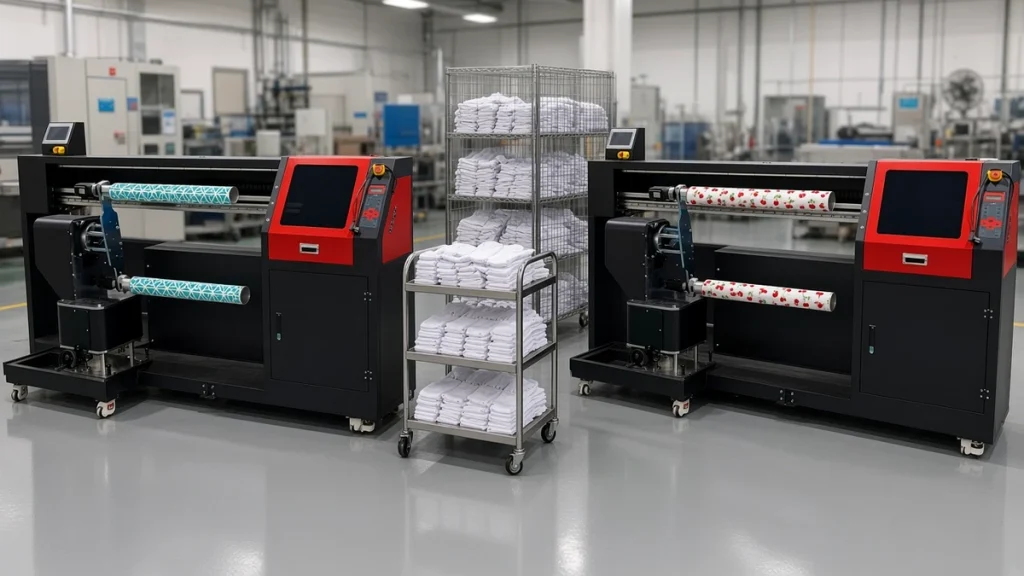
Every growing sock business reaches a point where one machine is not enough. Orders pile up, staff work overtime and lead times stretch. Adding a second socks printer can solve the problem, but only if it is the true bottleneck. This guide helps you decide when to scale and how.
Signs you may need more capacity
- The printer runs at full capacity every shift and you still have a backlog.
- Lead times are growing and customers are noticing.
- You regularly turn down orders or rush jobs.
- Maintenance is being skipped because the machine can never stop.
- A single breakdown would halt all production.
First, confirm the bottleneck
Before buying another printer, check the rest of the line. Is the oven keeping up? Are washers and dryers the real constraint on the cotton route? Is packing slowing things down? Measure output at each step for a week. If fixation or finishing is the bottleneck, invest there first. Our guide to planning a production line explains how.
Then, improve utilization
Sometimes capacity can be found without new equipment:
- Group jobs by sock size to reduce roller changes.
- Add a dedicated loader so printheads are never idle.
- Run a second shift.
- Improve workflow from order to queue. See connecting your online store.
- Reduce reprints through better maintenance and training.
If these steps are already in place and you are still at capacity, it is time to scale.
Choosing the second machine
Same model. Adding an identical machine simplifies training, spare parts and color profiles. Jobs can move freely between machines.
Higher-output model. If demand is mainly standard socks, a four-roller machine like the CO80-210PRO can add significant continuous output.
Different capability. If you are turning down long products or sleeves, a flexible machine like the CO60-100PRO broadens your range.
Dedicated sample or rush machine. A desktop model can handle samples and urgent personalized orders, freeing the main machine for production.
Redundancy has value
A second machine is not only about capacity. It provides backup. If one printer needs maintenance or a part, the other keeps orders moving. For businesses with strict delivery promises, this alone can justify the investment.
Scaling finishing equipment
Doubling print capacity usually means increasing fixation and finishing capacity too. A benchtop oven that kept up with one printer may not handle two. Consider moving to a continuous chain oven such as the COHE-1801 or the extended COHE-1802.
Scaling the team
More machines need more trained operators. Start training before the new machine arrives using our operator training plan. Cross-train staff so they can run any machine.
Financial check
Run the numbers again with our socks printer ROI method, using your actual order data. The second machine is usually easier to justify than the first because you have real sales history.
Signs you are ready
- Your printer runs full shifts most days and orders still wait.
- Lead times are growing and customers notice.
- You are turning down or delaying orders during peaks.
- Your team has documented processes that a new operator could follow.
Checking the rest of the line
A second printer only helps if finishing, packing and staffing keep up. Check oven or steamer capacity, washing and drying for cotton, and packing space. See planning a production line.
Same model or different?
Adding the same model simplifies training, spare parts and color matching. A different model can add capability, such as a multi-roller machine for higher volume. Compare options on our socks printer page.
Calculating the gap
Before buying a second socks printer, put numbers on the shortfall. Compare average and peak weekly orders with what your current line produces in a normal shift. If the gap only appears for a few weeks a year, extra shifts or better scheduling may be enough. If orders wait most weeks, a second machine is likely justified.
Alternatives to consider first
- Improve loading speed through training and better roller organization.
- Reduce downtime with a stronger maintenance routine and stocked spare parts.
- Batch smarter by fiber and size to reduce changeovers.
- Add a shift during busy seasons.
If these steps still leave a gap, expansion makes sense.
Financing and timing
Time the purchase so the new machine is installed, tested and staffed before your busy season, not during it. Factor in training and ramp-up. Our ROI guide helps you check that the extra capacity pays back.
Same team or new hires?
A second machine usually needs at least one more trained operator. Train them on the first printer before the second arrives, so both machines start productive from day one.
Conclusion
Add a second socks printer when the printer is truly the bottleneck and utilization is already high. Choose a model that fits your growth, whether identical, higher-output or different capability, and scale finishing and staff alongside it. To discuss your growth plans, compare models on the socks printer page or contact us.
Leave A Comment