Electric Blast Constant-Temperature Heating
A fan motor drives hot air to circulate inside the chamber, ensuring uniform temperature distribution and avoiding uneven curing caused by local temperature differences.
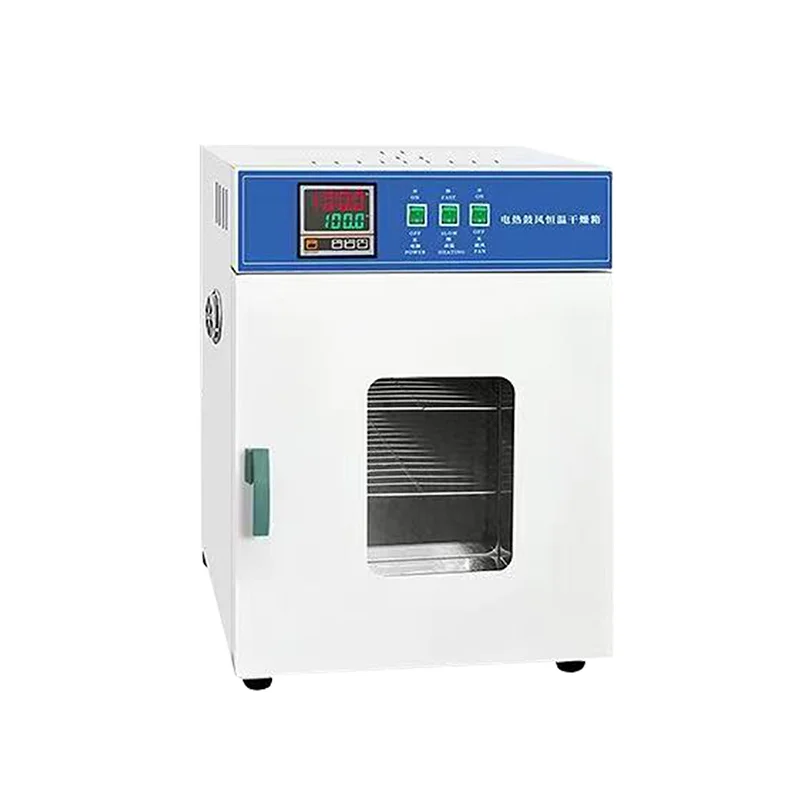
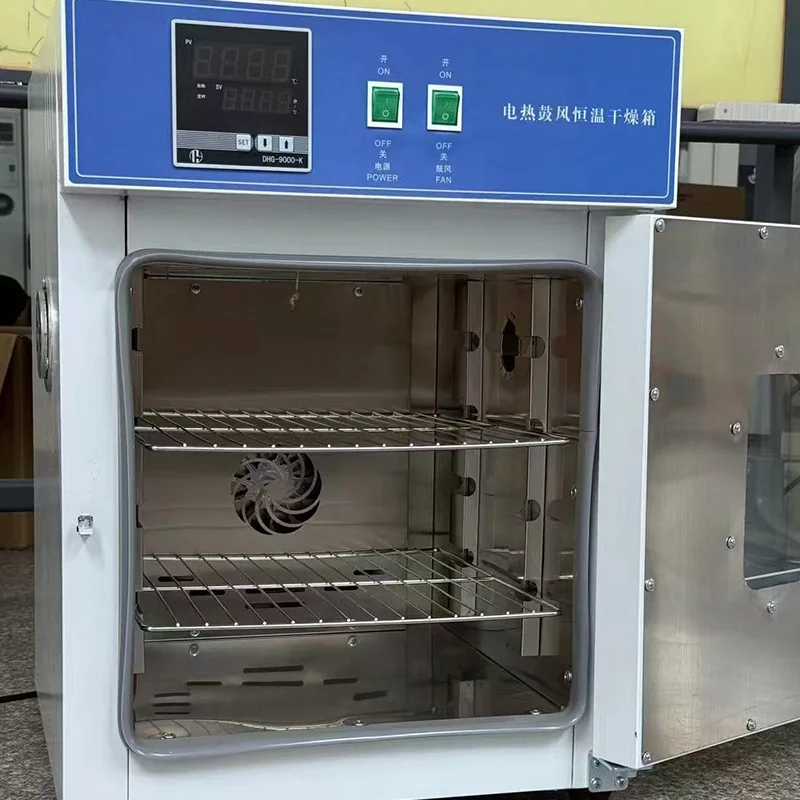
The COHE-150 is a compact benchtop sock heating oven designed for the heat-curing process of polyester socks after digital printing. With 220V/1500W single-phase power and a full stainless steel inner chamber, it uses electric blast constant-temperature heating to ensure uniform cavity temperature so that disperse inks fully cure on polyester fibers for vivid and long-lasting prints.
A fan motor drives hot air to circulate inside the chamber, keeping temperature distribution uniform and avoiding uneven curing from local temperature differences.
The inner chamber is high-quality stainless steel — heat-resistant, corrosion-resistant and easy to clean for long-term high-temperature operation.
High-precision digital temperature controller with dual PV/SV display; set temperature and real-time temperature are clearly visible for precise control.
Runs on standard 220V single-phase mains with no three-phase power needed; one batch every 8 minutes, ideal for studios, sample rooms and R&D labs.
The COHE-150 sock heating oven adopts an electric blast constant-temperature drying process with a full stainless steel inner chamber, designed specifically for heat curing of polyester socks after digital printing. Its compact benchtop body and 220V single-phase power keep the installation threshold low, while the digital controller maintains stable cavity temperature for consistent, vivid curing results.
As a downstream ancillary device in the Ningbo Colorido sock printer production line, the COHE-150 pairs with desktop sock printers such as the CO80-600DK. After printing, socks are laid flat on the stainless steel wire racks inside the oven, the door is closed, and heat curing proceeds — completing the full polyester sock printing workflow. With temperature adjustable up to 200°C and two heating power levels (FAST/SLOW), it is built for low-volume production, sampling and multi-style trial runs.
Factory reference parameters for the benchtop sock heating oven. Final values are subject to the ordered configuration and manufacturer confirmation.
| Device Name | Socks Oven | Commercial Model | COHE-150 |
|---|---|---|---|
| Product Name | Sock Heating Oven (Polyester) | Inner Lining Material | Stainless steel |
| Inner Dimensions | 450×350×450 mm | Overall Dimensions | 570×530×740 mm |
| Package Dimension | 100×100×1400 mm | Voltage and Power | 220V / 1500W |
| Heating Method | Electric blast constant-temperature heating | Temperature Controller | Digital controller, model DHG-9000-K, dual PV/SV display |
| Temperature Range | Room temperature ~ 200°C (adjustable) | Heating Power Levels | FAST / SLOW (two levels) |
| Control Switches | POWER, FAN, HEATING — three independent switches | Output per Batch | 5–6 pairs of socks (one batch every 8 minutes) |
| Power Supply | 220V single-phase mains | Door Window | Glass observation window |
| Chamber Racks | Multi-layer stainless steel wire racks, removable | ||
Six core capabilities that bring stable, uniform polyester sock heat curing to studios, sample rooms and low-volume production lines.
A fan motor drives hot air to circulate inside the chamber, ensuring uniform temperature distribution and avoiding uneven curing caused by local temperature differences.
The inner chamber is made of high-quality stainless steel — heat-resistant, corrosion-resistant and easy to clean, suited to long-term high-temperature operation and a longer service life.
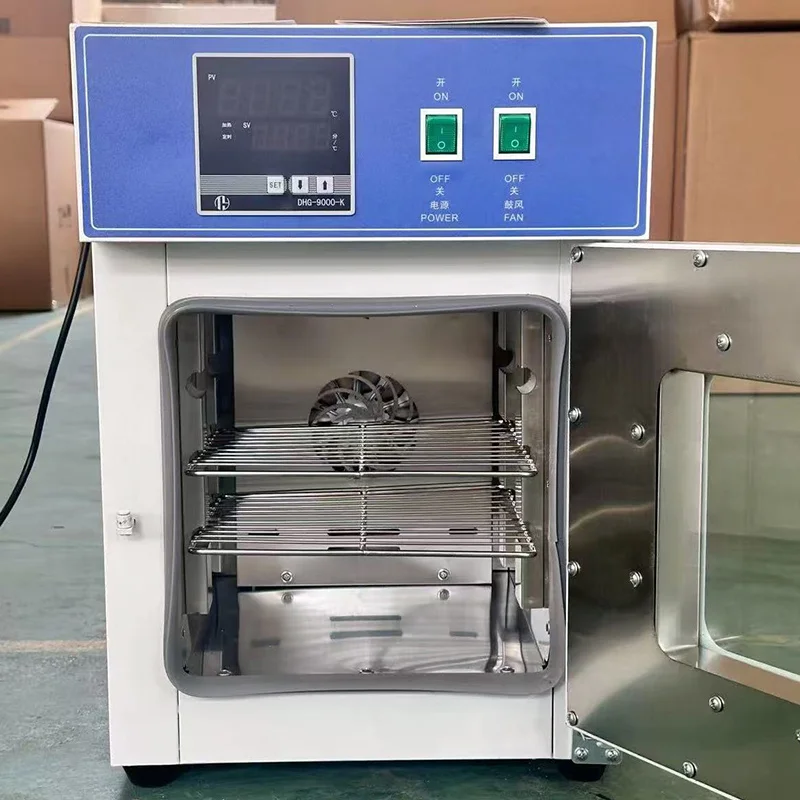
Equipped with a high-precision digital temperature controller (model DHG-9000-K) with dual PV/SV display; set temperature and real-time temperature are clearly visible for precise control.
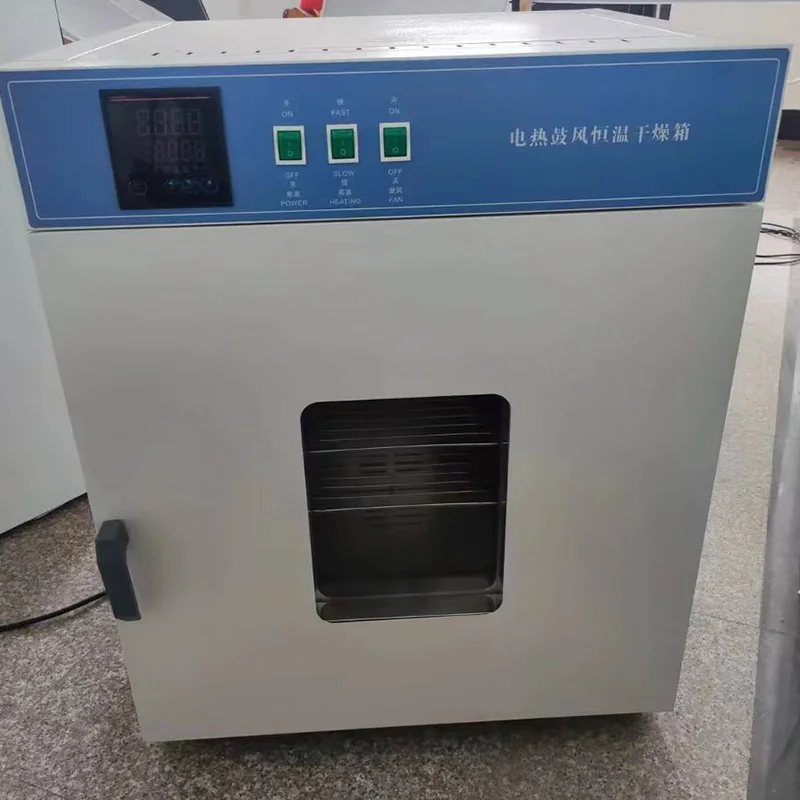
POWER, FAN and HEATING are three independent switches; heating has two levels (FAST/SLOW). Run the fan alone for cooling, or fan + heating in combination — flexible operation.
Overall dimensions of only 570×530×740mm with benchtop placement; 220V single-phase mains at 1500W needs no three-phase industrial power — ideal for studios and labs.
Processes approximately 5–6 pairs of socks per batch, one batch every 8 minutes, with layered removable stainless steel racks — positioned for R&D sampling and small-batch orders.
From the digital controller to the stainless steel chamber, every component is built for stable, uniform polyester heat curing on the benchtop.
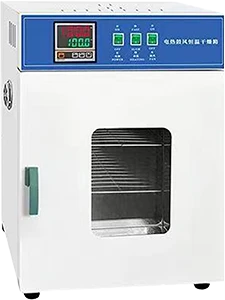
The top of the oven has a blue control panel with a high-precision digital temperature controller (model DHG-9000-K) on the left, featuring dual PV (process value) and SV (set value) displays and a SET key for temperature setting. Temperature is freely adjustable from room temperature up to 200°C, set flexibly according to fabric type, ink characteristics and curing process requirements.
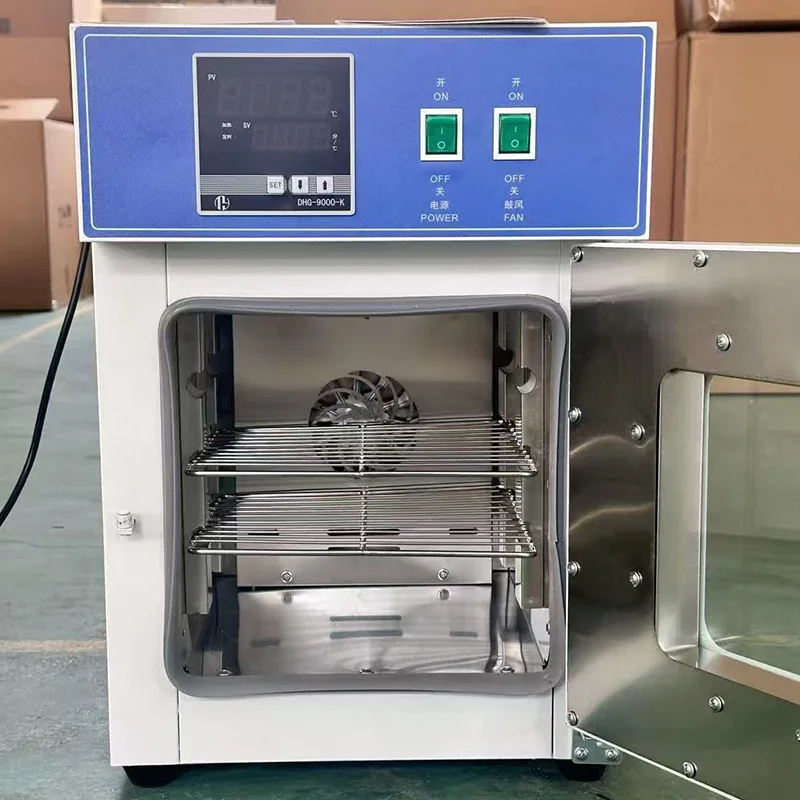
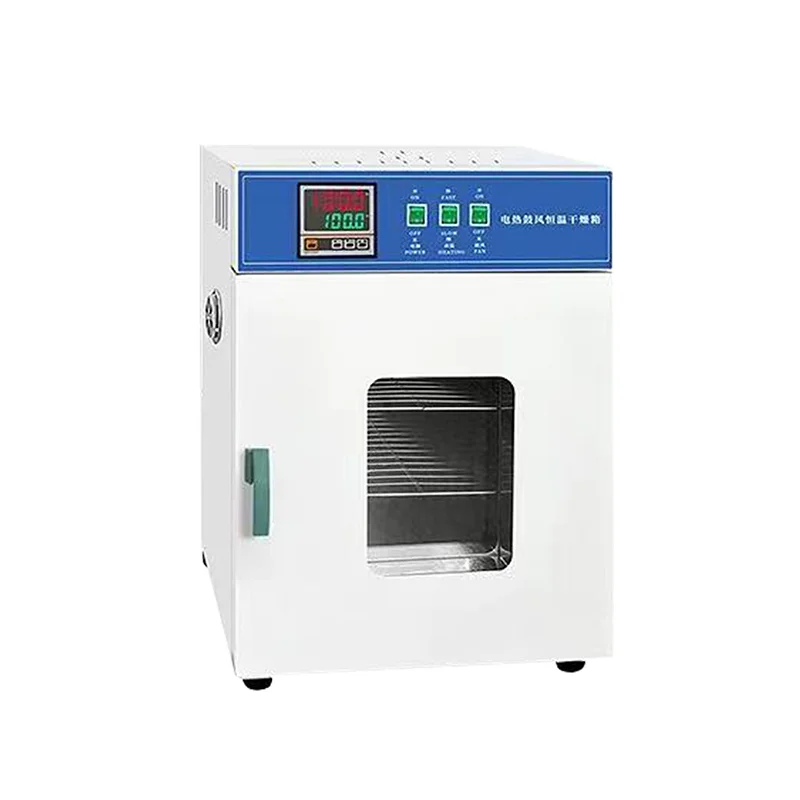
The oven features a white body with a blue control panel in a compact benchtop design. The front door has a rectangular glass observation window for real-time monitoring of the socks during heating without opening the door, and four anti-slip feet at the bottom keep the unit stable. Overall dimensions are only 570×530×740mm, taking little floor space in sample rooms and laboratories.
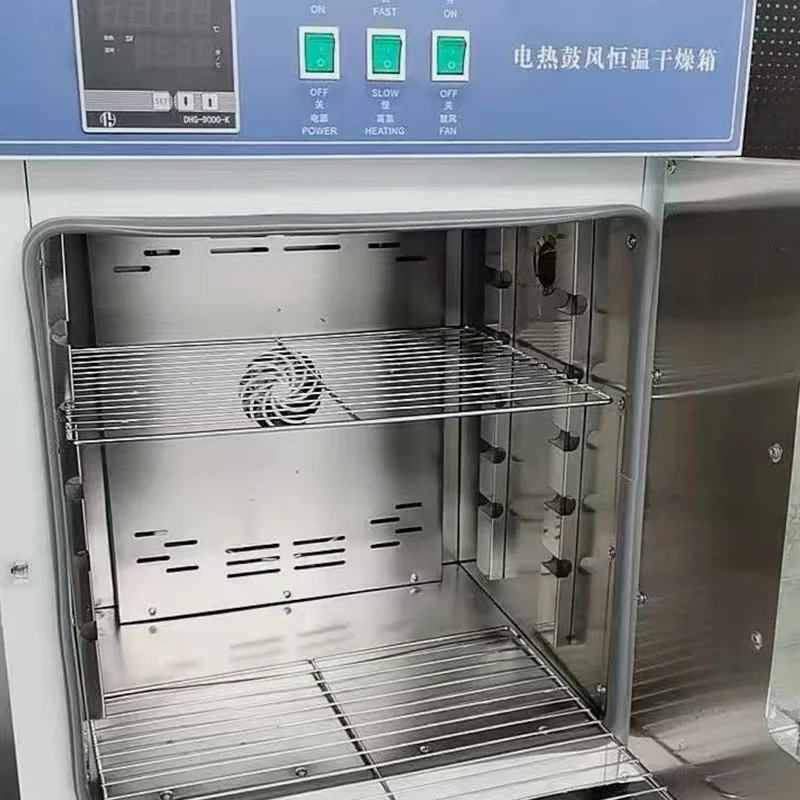
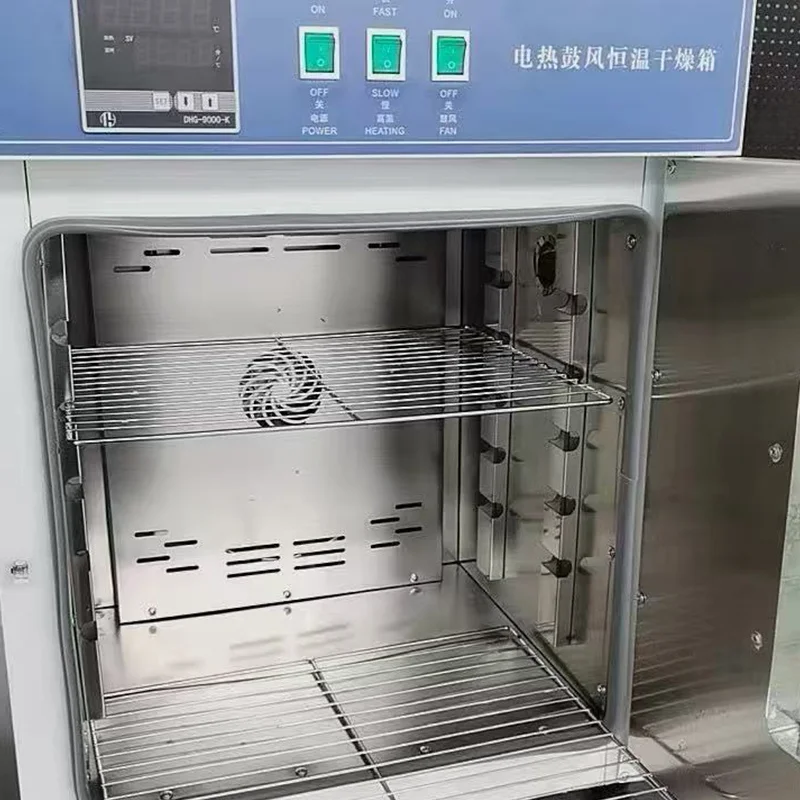
The inner chamber is made of full stainless steel with inner dimensions of 450×350×450mm — heat-resistant, corrosion-resistant and easy to clean, suited to long-term high-temperature operation. Ventilation holes and circulation air ducts are distributed on the chamber walls, working with the rear fan motor to achieve hot air circulation and ensure uniform temperature throughout the cavity.
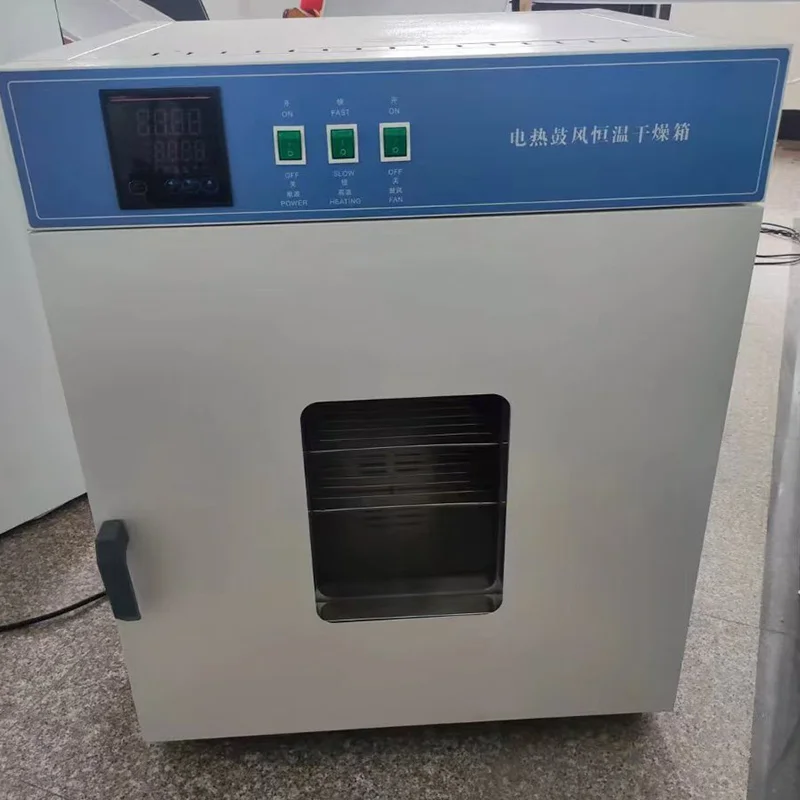
The COHE-150 uses electric blast constant-temperature drying: a fan motor drives hot air to circulate continuously inside the chamber, making temperature distribution uniform and avoiding uneven curing from local temperature differences. Heating (HEATING) has two levels — FAST for rapid heat-up and SLOW for stable temperature maintenance — while POWER, FAN and HEATING are three independent switches for flexible operation.
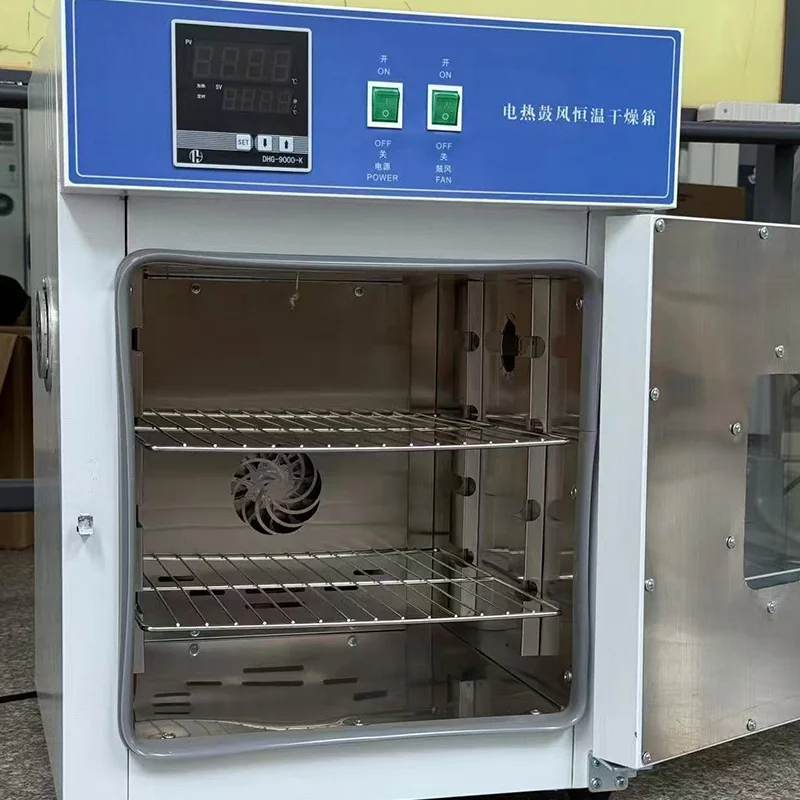
The chamber is fitted with multiple layers of removable stainless steel wire racks; socks are laid flat in layers without touching each other, so printed surfaces stay clean and easy to load and unload. The oven processes approximately 5–6 pairs of socks per batch, one batch every 8 minutes — positioned for R&D sampling, small-batch orders and multi-style trial production, with 220V single-phase power for plug-and-play use.
A quick look at how the blast constant-temperature heating system runs and cures polyester socks inside the benchtop chamber.

Studio Owner · Carter Custom Socks, USA
We run a ten-person custom sock studio on 220V mains and the COHE-150 dropped straight onto our workbench — no electrician, no three-phase install. Paired with our CO80-600DK, five to six pairs every eight minutes is exactly the sampling throughput we needed, and the disperse ink cures vividly at 200°C on every batch.

R&D Engineer · PolyLab K.K., Japan
Our R&D lab trials dozens of polyester designs each week. The DHG-9000-K controller with its PV/SV dual display lets me hold the cavity at a precise temperature, and the FAST/SLOW heating switch means I can ramp up quickly then stabilise — colour consistency across sample batches has never been this reliable, and the benchtop size fits our lab bench perfectly.

QA Manager · Thames Textiles, United Kingdom
Colourfastness on polyester was our recurring QA failure. Since curing with the COHE-150's blast hot-air circulation, the full stainless-steel chamber holds an even temperature and our wash tests now pass first time. Watching through the glass observation window without opening the door is a small but real time-saver on every run.

Workshop Owner · MeiaPrint Studio, Brazil
I work from a converted garage workshop and could never justify industrial three-phase power. The COHE-150 runs off a normal 220V socket at 1500W, the multi-layer stainless racks keep socks from touching, and five to six pairs a batch covers all my small custom orders — a genuinely low-barrier way to bring heat curing in-house without rewiring the building.

Production Lead · Fenix Socks B.V., Netherlands
We produce many short runs of multi-style polyester socks. Being able to load a batch, set the temperature up to 200°C, and let the independent FAN and HEATING switches run the cure means quick changeovers with zero cross-contamination. One batch every eight minutes keeps our sample room moving and the compact footprint leaves room for the printers beside it.
Common questions about polyester sock heat curing, heating method, capacity, power and pricing — then send your requirements for a configuration recommendation.
The COHE-150 is a high-temperature heat curing device for polyester socks after digital printing, used to fully cure disperse inks on polyester fibers and improve print fastness and color rendition. It is typically used as a downstream ancillary device to Ningbo Colorido sock printers (e.g., the CO80-600DK). After printing, socks are laid flat on the stainless steel racks inside the oven, the door is closed, and heat curing proceeds.
The COHE-150 uses electric blast constant-temperature heating. A fan motor drives hot air to circulate continuously inside the chamber, ensuring uniform temperature distribution and avoiding uneven curing from local temperature differences. Heating power has two levels (FAST/SLOW), and the fan (FAN) and heating (HEATING) can be controlled independently.
It holds approximately 5–6 pairs of socks per batch, completing one batch every 8 minutes. Actual output varies with sock thickness, loading, and curing temperature/time settings. This capacity is positioned for low-volume and sampling production; for high-volume continuous production, the COHE-1801 chain oven is recommended.
Yes, the temperature is adjustable from room temperature up to 200°C. The specific curing temperature and time should be determined through sample testing based on fabric type, ink model, print coverage, and loading — do not apply generic parameters. After curing, color, fastness, print appearance, and dimensional stability should be inspected.
The COHE-150 runs on 220V single-phase mains power at 1500W. Standard household or commercial outlets suffice — plug-and-play, no three-phase industrial power required, low installation threshold.
The COHE-150 is a compact benchtop oven with 220V single-phase power (1500W), 5–6 pairs per batch — suited to low-volume and sampling. The COHE-1801 is a large chain oven with three-phase 380V power (15KW), ~450 pairs/hour — suited to high-volume continuous production. Both are polyester sock heat curing devices; select based on capacity needs.
The inner chamber is full stainless steel — heat-resistant, corrosion-resistant, and easy to clean. The chamber has multiple removable stainless steel wire racks; socks are laid flat in layers without touching. The door has a glass observation window for real-time progress monitoring. The unit is benchtop and compact at 570×530×740 mm.
The COHE-150 is an ancillary finishing device in the digital printing production line, typically paired with Ningbo Colorido sock printers (CO80-600DK, etc.) to form a complete print — dry — cure workflow. For independent use in other high-temperature processes, compatibility should be evaluated separately.
Ningbo Colorido needs to confirm the applicable product scope, fabric and ink process, curing parameter requirements, power configuration (220V single-phase mains), installation site, ventilation and heat exhaust, packaging, destination, training, service, and sampling standards. Price, lead time, warranty, and installation conditions are subject to the current written quotation.
Other Ningbo Colorido pretreatment and finishing machines that round out the lineup alongside the COHE-150 benchtop sock heating oven — alternative models for washing, drying, heat fixation and steaming.