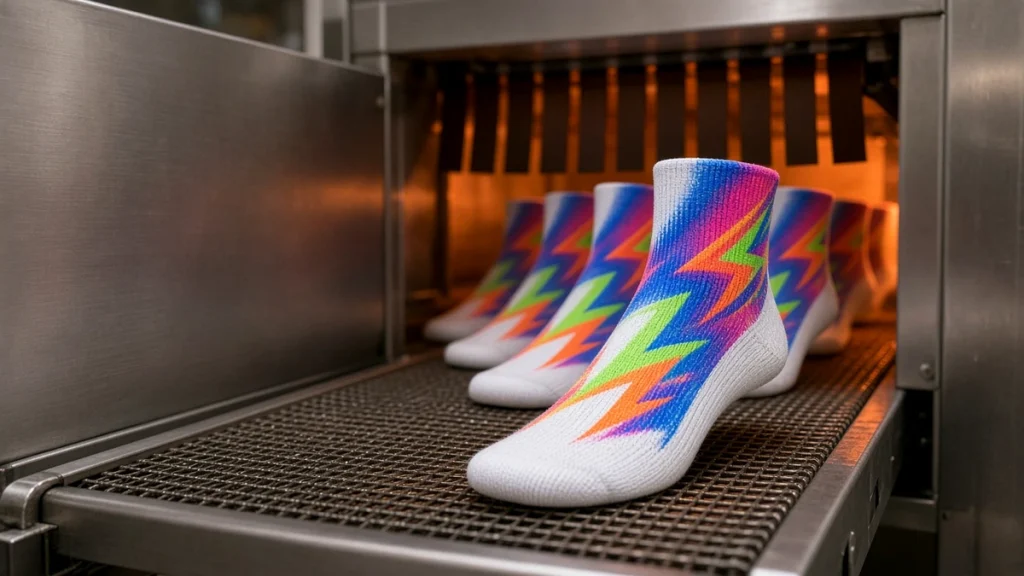
In a polyester printing line, the sock oven is easy to overlook. It does not have printheads or color software, and it looks simple: socks go in, socks come out. Yet the oven decides whether colors reach full brightness and whether prints survive washing. A great print can be ruined by poor fixation.
What heat fixation does
Disperse inks used on polyester sit on and around the fibers after printing. When heated, polyester fibers open slightly and the dye moves into them. As the socks cool, the dye is locked inside. This process brings colors to full vibrancy and makes prints wash-resistant.
Signs of under-fixation
- Dull, weak colors.
- Color transfer when rubbed.
- Bleeding or fading in the first wash.
Signs of over-fixation
- Yellowing of white areas.
- Changes to elastic or trims.
- Stiffness or altered hand feel.
The goal is consistent, correct temperature and time for your ink and fabric.
Types of sock ovens
Benchtop ovens. Compact units for small batches and studios. The COHE-150 is a 1.5 kW benchtop oven suited to small-scale polyester fixation.
Conveyor-chain ovens. Socks hang on a moving chain through a heated chamber, giving continuous fixation that matches production printers. The COHE-1801 is a 15 kW chain oven, and the COHE-1802 is a 30 kW extended-chain version for higher capacity.
Low-temperature cotton ovens. Designed for reactive ink fixation on cotton rather than disperse fixation. See the COHE-1803.
Our article on choosing a sock oven compares them in more detail.
Keys to consistent fixation
- Stable temperature. Circulating air helps even heat distribution.
- Correct dwell time. Chain speed or batch time must match ink requirements.
- Even loading. Avoid overlapping socks that block airflow.
- Regular verification. Check temperature with an independent thermometer periodically.
- Clean chamber. Lint buildup affects airflow and safety.
Matching oven capacity to printer output
An oven that cannot keep up creates a pile of unfixed socks. A chain oven sized to your printer's real output keeps the line flowing. See planning a production line around your socks printer.
Safety
- Ensure good ventilation; ovens release heat.
- Keep the area clear of flammable materials.
- Train staff on hot surfaces.
- Follow electrical requirements.
Testing new combinations
Every time you change ink, blank supplier or design coverage significantly, test fixation: print samples, fix at standard settings, wash test and compare colors. Adjust only one variable at a time.
Common fixation mistakes
- Too short or too cool: colors look weak and fade in washing.
- Too long or too hot: possible yellowing or fabric damage.
- Overloading: uneven heat leaves some socks under-fixed.
- Skipping tests after changes: a new blank or ink may need different settings.
Building a fixation routine
Record time and temperature for each fiber and product, check equipment regularly and wash-test samples from new batches. A short checklist at the oven keeps results consistent between operators.
Fixation and the whole process
Fixation is one step in a chain that includes printing, washing and drying. Read choosing a sock oven and how durable are digital print socks.
Signs of good fixation
How do you know a batch has been fixed correctly? Check these points after the oven and again after a wash test:
- Colors look as strong as the approved sample.
- Dark areas are deep and even, not patchy.
- Rubbing with a damp white cloth transfers little or no color.
- White areas stay clean after washing.
- The sock feels soft and keeps its shape.
If results drift, check oven settings, load size and the blank batch before changing the print file. Equipment options include the sock heating oven and socks oven pages.
Fixation for different fibers
Polyester printed with disperse inks is fixed with dry heat in an oven. Cotton printed with reactive inks is usually fixed with steam, then washed. Mixing up these routes is a common cause of weak results for businesses that print both fibers. Label batches clearly by fiber and keep separate settings sheets for each. See steaming vs oven fixation.
Frequently asked questions
Can I use a heat press instead of a sock oven?
Heat presses flatten socks and are not suited to rotary-printed tubes. A dedicated sock oven fixes the whole tube evenly.
How long does fixation take?
It depends on ink and oven design. Follow your ink supplier's guidance and verify with tests.
Does cotton need an oven?
Cotton with reactive ink uses steam or a low-temperature oven, followed by washing. See steaming vs oven fixation.
How often should I check settings? At least whenever you change blank, ink or load size, and with a regular wash test of production samples.
Conclusion
The sock oven completes the print. Correct, consistent heat fixation brings colors to life and makes them last. Choose an oven sized to your output, verify temperatures and test new combinations. Explore the pretreatment and finishing range or contact us for help choosing.
Leave A Comment